

Choose the Right Industrial HOCl System
Choosing an industrial hypochlorous acid generator requires more than comparing prices. You need to understand production capacity, chlorine concentration, water quality, and operating costs. The right system can improve disinfection, reduce chemical handling, and support daily production.
At Shandong Shine Health, we believe that every industrial facility needs a solution that matches its actual workflow. A small machine may struggle with continuous production. An oversized system may increase investment without adding real value. In this guide, we explain what buyers should check before purchasing an industrial HOCl generation system.
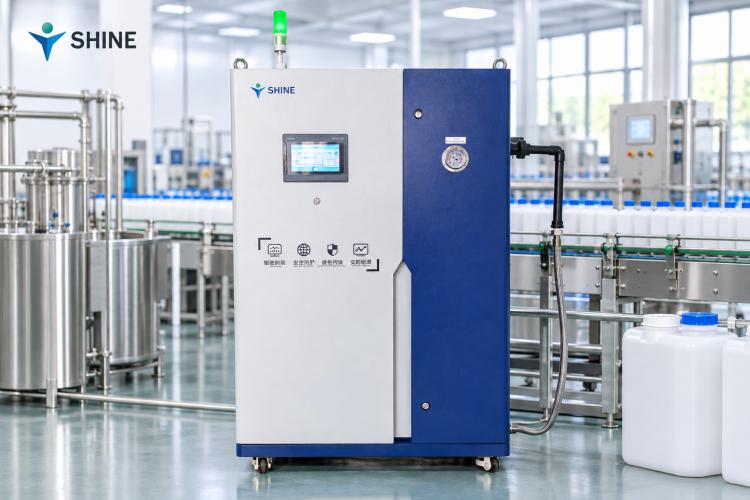
1. Understand How an Industrial HOCl Generator Works
An industrial hypochlorous acid generator uses electrolysis to produce hypochlorous acid (HOCl) on-site. The system uses water, an electrolyte, and electrical energy to generate an active chlorine solution. Depending on the equipment design, the electrolyte may contain salt (NaCl) or dilute hydrochloric acid (HCl).
The Basic Electrolysis Process
The production process generally includes several steps:
Feedwater enters the treatment system.
The equipment prepares the required electrolyte.
Electrical current passes through the electrolyte inside an electrolysis cell.
Electrochemical reactions generate active chlorine species.
The system produces HOCl-containing water at the required concentration.
Operators send the fresh solution directly to the application point.
In simple terms, the machine uses an electrical current through a salt solution to generate HOCl. However, different electrolysis technologies produce different chemical profiles. Therefore, buyers should check the actual output rather than rely on product names alone.
Why Industrial Facilities Choose On-Site Production
Traditional chemical supply often requires transportation, storage, and regular purchasing. An on-site hypochlorous acid machine reduces dependence on ready-made disinfectant supplies. It also allows operators to adjust production according to actual demand.
For example, a food processing plant may need different production volumes during peak and low-production periods. An automatic HOCl generator can help match output with changing demand. This approach also reduces the need to handle large quantities of harsh chemicals.
2. Check Production Capacity and Chlorine Concentration
Capacity is one of the most important buying factors. A machine must produce enough solution to support every application point. However, buyers should not confuse solution flow with effective chlorine production.
Calculate Your Daily HOCl Requirements
Start by listing all disinfection points in your facility.
Consider these questions:
How many production lines operate each day?
How much disinfectant does each line consume?
How many hours does the equipment run?
Do you need continuous production or batch production?
Will demand increase during future expansion?
For example, a facility that uses 100 L/h at 50 ppm needs a different configuration from one requiring 300 L/h at 200 ppm.
You should also calculate the daily effective chlorine demand.
Effective Chlorine Output (g/h) = Flow Rate (L/h) × Concentration (ppm) ÷ 1,000
For example:
300 L/h × 100 ppm ÷ 1,000 = 30 g/h.
This calculation helps you compare different machines using the same measurement.
Is 500 ppm the Right Concentration?
Not necessarily. The ideal concentration depends on the application, contact time, water quality, and regulatory requirements.
Some industrial processes may require higher concentrations, including configurations around 500 ppm. However, food-contact applications must follow the relevant approval and operating conditions. For example, certain FDA food-contact notifications specify a maximum of 60 ppm free available chlorine for particular uses.
Therefore, never select a machine simply because it produces a higher ppm value. Instead, match its output to your validated disinfection process.
3. Evaluate Water Quality and HOCl Output
Water quality directly affects generator performance. Even a powerful machine cannot deliver consistent results when feedwater quality changes significantly.
Check Your Tap Water Before Purchasing
Some facilities use tap water directly. Others need additional water treatment before electrolysis.
Important water parameters include:
pH: Influences the balance between HOCl and other chlorine species.
Hardness: High calcium and magnesium levels may cause scale.
Chloride (Cl⁻): Affects the electrochemical process.
Conductivity: Influences electrical performance.
Temperature: Can affect reaction conditions and output stability.
Organic matter: May increase disinfectant demand.
We recommend testing the actual water source before equipment installation. A suitable pretreatment system can improve operating stability and reduce maintenance.
Understand HOCl and Sodium Hypochlorite
Hypochlorous acid (HOCl) and sodium hypochlorite (NaOCl) belong to the same chlorine-based disinfection family. However, they are not interchangeable product descriptions.
Their chemical balance depends strongly on pH. At suitable pH conditions, free chlorine exists mainly as HOCl. At higher pH levels, the balance shifts toward hypochlorite ions (OCl⁻).
An industrial HOCl generator should therefore control important output parameters, including:
Free available chlorine (FAC)
pH value
Production flow
Solution temperature
Output consistency
This information helps buyers understand what the system actually produces.
4. Choose the Right Industrial Applications
An industrial HOCl generator can support different sanitation processes. However, each application requires suitable equipment settings and validated operating conditions.
Food Processing and Equipment Sanitation
Food processing facilities need reliable sanitation for production areas and equipment. HOCl-containing electrolyzed water can support applications involving fruits, vegetables, seafood, meat-processing equipment, and food-contact surfaces.
Before selecting a machine, confirm the following:
Required free available chlorine concentration
Approved food-contact application
Contact time
Water temperature and pH
Rinsing or drainage requirements
Material compatibility
Do not assume that every HOCl solution automatically meets food-contact regulations. Different applications and regulatory approvals have specific conditions.
Other Industrial Applications
Industrial HOCl systems can also support:
Commercial cleaning operations
Livestock facilities
Agricultural sanitation
Institutional sanitation
Equipment surface disinfection
Selected water treatment applications
For every application, operators should verify the required microbial reduction and contact time. Effective disinfection depends on more than concentration alone.
5. Compare Equipment Features Before Buying
A reliable hypochlorous acid machine needs more than an electrolysis cell. Its supporting components also affect long-term performance.
Essential System Components
We recommend checking these components before making a purchase:
Component | Main Function |
Water pretreatment | Improves feedwater quality |
Salt or electrolyte tank | Supplies the required electrolyte |
Electrolysis cell | Generates active chlorine |
Power supply | Controls electrical operation |
Control panel | Manages operating parameters |
Flow control | Regulates solution production |
Monitoring instruments | Tracks pH and chlorine concentration |
Collection tank | Receives freshly generated solution |
The exact configuration depends on the generator technology. Ask the manufacturer for a complete process diagram and equipment list.
Automatic Control and Safety
An automatic HOCl generator should provide clear operating information. Useful features include:
Automatic start and stop
Flow monitoring
Electrical current monitoring
Low-water protection
Abnormal-operation alarms
Emergency shutdown
Hydrogen ventilation where applicable
Hydrogen management deserves special attention. Some electrolysis processes generate hydrogen as a by-product. Proper ventilation and suitable safety controls help reduce operational risks.
Also check electrode materials, corrosion resistance, maintenance access, and replacement costs. These details often matter more than an attractive control panel.
6. Calculate Cost Effectiveness and Long-Term Value
The purchase price represents only one part of the investment. A proper buying decision should include operating costs over several years.
Calculate the Total Operating Cost
Consider these cost categories:
Initial equipment investment
Salt or electrolyte consumption
Electricity consumption
Feedwater and pretreatment costs
Routine maintenance
Electrode replacement
Labor and monitoring costs
A useful calculation is:
Daily Operating Cost = Salt + Electricity + Water + Labor + Maintenance
Then calculate:
Cost per kg of Available Chlorine = Daily Operating Cost ÷ Daily Available Chlorine Output
This formula helps compare an on-site HOCl generator with purchased disinfectants.
However, remember to compare solutions at equivalent effective chlorine concentrations. Otherwise, the result may give a misleading impression of cost effectiveness.
An environmentally friendly production approach can also reduce packaging and transportation needs. Still, buyers should evaluate electricity use, wastewater, and chemical consumption before making environmental claims.
7. Check Stability, Maintenance, and Supplier Support
Fresh production offers an important operational advantage. HOCl can lose strength over time because of light, heat, air exposure, and other storage conditions.
Can HOCl Last for 90 Days?
Some buyers ask whether generated HOCl can maintain its concentration for 90 days. The answer depends on the production technology, pH, concentration, container material, temperature, and storage conditions.
Some specially designed formulations may maintain stability for extended periods. However, buyers should not assume that every freshly generated solution has a 90-day shelf life.
We recommend requesting real stability test data from the manufacturer. The test should measure free available chlorine at different storage intervals.
For industrial applications, generating HOCl close to the point of use often provides better control. It also reduces the need for long-term storage.
Questions to Ask Your Manufacturer
Before signing a purchase agreement, ask:
What is the actual production capacity?
Can the concentration be adjusted?
What feedwater quality does the machine require?
How often should operators maintain the electrolysis cell?
What is the expected electrode service life?
Does the system include automatic protection?
What installation conditions does it require?
Can the supplier provide technical support and spare parts?
A professional manufacturer should answer these questions clearly.
8. How to Find the Best Industrial HOCl Generator
The best hypochlorous acid generator is not always the largest or most expensive model. It is the system that matches your production needs, water conditions, and application requirements.
You may also see search terms such as hypochlorous acid machine, hypochlorous acid maker, acid generator, and hypochlorous acid generator for home use. These terms describe a broad product category, but industrial buyers need different specifications from household users.
A home-use machine may suit small daily requirements. An industrial HOCl generator needs higher production capacity, stable operation, automatic controls, and reliable technical support.
At Shandong Shine Health, we focus on practical HOCl generation solutions for industrial customers. Our systems support adjustable concentration and controllable solution flow. We also help customers evaluate their production requirements before selecting equipment.
If you want to generate HOCl on-site, start with your required flow rate, target ppm, daily operating hours, and feedwater quality. These four factors provide a strong foundation for equipment selection.
Contact Shandong Shine Health to discuss your industrial HOCl generator requirements. We can help you identify a suitable system for your application.