

How to Size an On-Site Hypochlorite System
Choosing the right disinfection capacity can make a major difference in water treatment performance. An undersized system may struggle during peak demand. An oversized system can increase equipment costs and waste energy. Neither option makes a good investment.
At Shandong Shine Health, we believe every water treatment project needs a carefully sized disinfection system. The right capacity depends on water flow, chlorine demand, operating hours, and water quality. Engineers must also consider future expansion and daily operating conditions.
An on-site sodium hypochlorite generator produces disinfectant at the treatment plant. This approach helps water operators control production and dosing. However, successful operation starts with accurate system sizing. In this guide, we explain each step with practical formulas, examples, and engineering considerations.
1. Understand the Basic Sizing Requirements
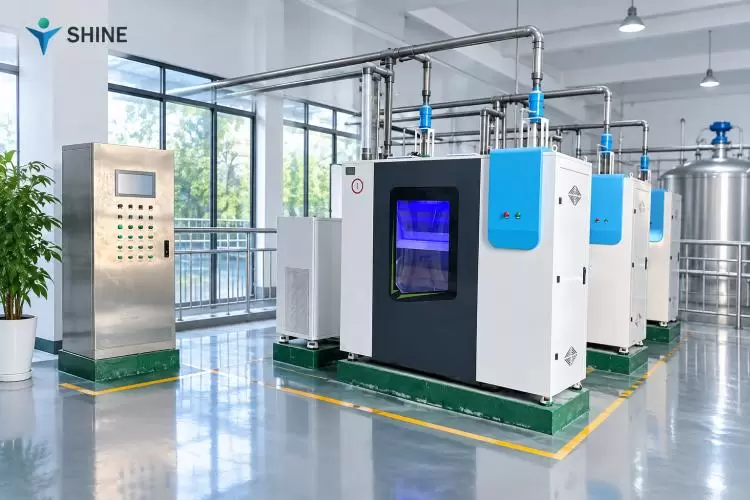
Before selecting equipment, we need to understand what the treatment process requires. A hypochlorite generation system must match actual chlorine demand. Water flow alone cannot determine the correct equipment capacity. Two plants may process the same water volume but need different chlorine outputs.
What Determines Hypochlorite System Capacity?
Several factors affect the required generation capacity:
· Daily water flow: Total water volume that the plant treats each day.
· Chlorine dose: Required chlorine concentration in mg/L.
· Chlorine demand: Amount of chlorine that water consumes during treatment.
· Contact time: Time available for chlorine to react with contaminants.
· Residual chlorine: Required free chlorine concentration after contact.
· Operating hours: Number of hours the generator runs each day.
· Peak demand: Maximum chlorine requirement during busy operating periods.
· Future expansion: Expected increases in water supply or treatment capacity.
We recommend collecting actual operating data before choosing a machine. Historical water quality records can reveal seasonal changes. They also help engineers identify unusual demand peaks.
Understand the Difference Between Water Flow and Chlorine Demand
Water flow describes how much water enters the treatment system. Chlorine demand describes how much disinfectant the water requires. These two values work together, but they are not interchangeable.
For example, a plant may process 10,000 m³/day. If the average chlorine dose reaches 2 mg/L, the daily requirement equals 20 kg of available chlorine. However, engineers must adjust this estimate for actual chlorine demand, residual targets, and operating conditions.
2. Calculate the Daily Chlorine Requirement
The most important step involves calculating the available chlorine requirement. This value forms the foundation of equipment selection. We use water flow and the required chlorine dose to estimate daily production.
The Basic Chlorine Demand Formula
For most water treatment projects, engineers can use this formula:
M = (Q × D) / 1000
Where:
· M = Daily available chlorine requirement (kg/day)
· Q = Daily water flow (m³/day)
· D = Required chlorine dose (mg/L)
· 1000 = Unit conversion factor
Remember that 1 mg/L equals 1 g/m³. Therefore, 1,000 m³ of water needs 1 kg of available chlorine at a dose of 1 mg/L.
For example, consider a water treatment plant with these conditions:
Parameter | Design value |
Daily water flow | 10,000 m³/day |
Average chlorine dose | 2 mg/L |
Operating time | 20 hours/day |
Production concentration | 0.8% |
Estimated daily chlorine demand | 20 kg/day |
The calculation looks like this:
M = (10,000 × 2) / 1000 = 20 kg/day
This plant needs 20 kg of available chlorine each day. However, the generator must also meet the required hourly production rate.
Calculate the Required Hourly Production Capacity
Daily production alone cannot determine the generator model. We must also consider the actual operating schedule.
P = M / H
Where:
· P = Required chlorine production (kg/h)
· M = Daily chlorine requirement (kg/day)
· H = Daily operating hours (h/day)
For our example:
P = 20 / 20 = 1 kg/h
Therefore, the basic production requirement equals 1 kg/h. We should also consider peak demand, equipment availability, and future operating changes.
A practical design may include a suitable capacity allowance. For example, a 20% allowance gives:
Pᵈ = 1 × 1.2 = 1.2 kg/h
This example uses a 20% planning allowance, not a universal engineering rule. Actual margins should reflect project data and local requirements.
3. Select the Correct Generator Output Concentration
After calculating chlorine demand, we need to determine the required solution concentration. This parameter directly affects the generator's solution output and dosing equipment.
An on-site sodium hypochlorite generator produces sodium hypochlorite solution through electrolysis. The system converts salt, water, and electricity into an available chlorine solution. Engineers must match the production concentration to the dosing design.
Calculate the Required Solution Flow
The following formula helps determine the required solution volume:
V = (P × 1000) / C
Where:
· V = Solution production (L/h)
· P = Available chlorine production (kg/h)
· C = Available chlorine concentration (g/L)
For example, assume the generator produces 1.2 kg/h of available chlorine. The selected solution concentration equals 8 g/L, or approximately 0.8% on a weight-per-volume basis.
V = (1.2 × 1000) / 8 = 150 L/h
The generator therefore needs to produce approximately 150 L/h of solution. Always confirm whether the manufacturer's concentration refers to available chlorine, NaOCl content, weight percentage, or volume-based concentration. These values do not always mean the same thing.
Why Does Production Concentration Matter?
Different treatment plants have different dosing requirements. A suitable concentration helps engineers balance production volume, storage capacity, and dosing pump performance.
Consider these important factors:
· Dosing pump range: The pump must handle the required solution flow.
· Chemical stability: Temperature, sunlight, and storage time affect hypochlorite quality.
· Pipeline design: Pipe diameter and material must suit the chemical solution.
· Storage volume: Tank capacity should match production and consumption schedules.
· Injection pressure: The dosing pump must overcome pipeline pressure.
We recommend checking the complete dosing process before selecting the generator. A high-capacity machine cannot solve a poorly designed injection system.
4. Consider Peak Demand and Water Quality
Average chlorine demand provides a useful starting point. However, actual demand changes with raw water quality and operating conditions. A reliable treatment system must handle these changes without losing control.
Evaluate Seasonal and Daily Water Quality
Raw water rarely maintains exactly the same quality throughout the year. Rainfall, temperature, organic matter, and industrial discharge can change chlorine demand. Therefore, engineers should review water quality records from different seasons.
Important water quality parameters include:
· pH value
· Water temperature
· Turbidity (NTU)
· Ammonia concentration (mg/L)
· Iron and manganese levels (mg/L)
· Organic matter and natural organic carbon
· Microbial contamination
· Existing chlorine demand
These factors influence chlorine consumption and disinfection performance. For example, ammonia can react with chlorine and form chloramines. Organic matter can also consume chlorine and contribute to disinfection by-product formation.
We strongly recommend conducting chlorine demand tests with representative water samples. This step gives engineers a more realistic design value than an assumed dose.
Check Contact Time and Residual Chlorine
A correct chlorine dose does not automatically guarantee effective disinfection. Engineers must also consider contact time, pH, and temperature. The CT value describes the relationship between disinfectant concentration and contact time.
CT = C × T
Where:
· C = Disinfectant residual (mg/L)
· T = Effective contact time (minutes)
· CT = Disinfection exposure (mg·min/L)
The WHO provides a general drinking-water reference of at least 0.5 mg/L free chlorine after 30 minutes at pH below 8.0. It also recommends maintaining at least 0.2 mg/L at the point of delivery. However, local regulations and actual pathogen risks determine the final design requirements. (WHO drinking-water guidance; see reference links below.)
Remember that the effective contact time may differ from the tank's theoretical retention time. Engineers should consider hydraulic conditions and short-circuiting. Otherwise, some water may receive less contact time than expected.
For wastewater treatment facilities, the design must also reflect the specific wastewater treatment processes. For example, activated sludge systems usually require careful control of biological treatment conditions. Engineers should avoid applying chlorine before biological treatment unless the process specifically requires it.
5. Design Storage, Dosing, and Equipment Capacity
Generator capacity represents only one part of the complete hypochlorite system. A successful project also needs suitable storage tanks, dosing pumps, pipelines, electrical controls, and safety equipment.
Determine the Required Storage Tank Volume
Storage capacity depends on production time, daily consumption, and operating strategy. Some plants prefer continuous production and dosing. Others use scheduled production to match water demand.
Vₛ = R × Tₛ
Where:
· Vₛ = Required usable storage volume (L)
· R = Average solution consumption (L/h)
· Tₛ = Required storage coverage (h)
For our previous example, the solution consumption equals 150 L/h. If the plant requires four hours of usable storage:
Vₛ = 150 × 4 = 600 L
Therefore, the plant needs at least 600 L of usable solution storage under these assumptions. Engineers should add suitable allowance for operating levels, tank geometry, and control limits.
However, bigger tanks do not always mean better performance. Sodium hypochlorite can lose available chlorine during storage. Heat, sunlight, contamination, and long storage periods can accelerate this process. Ontario's drinking-water design guidance discusses suitable storage conditions and the need to account for chemical decay.
We recommend designing storage around actual consumption rather than keeping unnecessary large volumes.
Match the Dosing Pump to Actual Demand
The dosing pump transfers the generated solution into the treatment process. Its capacity must cover minimum and maximum operating conditions.
For a reliable dosing arrangement, check:
1. Maximum water flow and chlorine dose.
2. Minimum operating flow and dosing rate.
3. Injection point pressure.
4. Pipeline length and diameter.
5. Chemical compatibility of wetted materials.
6. Flow control and automatic adjustment.
7. Backup pump requirements.
Variable water flow requires special attention. A fixed dosing rate may cause overdosing during low demand. During peak flow, the same setting may provide insufficient chlorine. Flow-paced dosing and residual feedback can help operators maintain more stable conditions.
6. Evaluate Operating Costs and Long-Term Performance
A good treatment system should do more than meet today's chlorine demand. It should also control operating costs and support reliable production over the long term.
When comparing different hypochlorite generation system manufacturers, we recommend looking beyond the initial equipment price. A cheaper machine may create higher electricity, maintenance, or chemical costs later.
Calculate the Main Operating Costs
An on-site hypochlorite generation system normally consumes salt, electricity, and water. It also requires labor, maintenance, and occasional replacement parts.
Cᵈ = Cₛ + Cₑ + Cw + Cₗ + Cₘ
Where:
· Cᵈ = Total daily operating cost
· Cₛ = Daily salt cost
· Cₑ = Daily electricity cost
· Cw = Daily water cost
· Cₗ = Daily labor cost
· Cₘ = Daily maintenance cost
For a more useful comparison, calculate the cost per kilogram of available chlorine:
Cₖg = Cᵈ / M
This calculation helps operators compare different production systems. It also makes long-term budget planning easier.
However, equipment price should never become the only selection factor. We suggest comparing the following items:
Cost factor | What to evaluate |
Initial investment | Generator, tanks, pumps, and installation |
Salt consumption | Daily salt use and local salt prices |
Electricity | Power consumption and operating hours |
Water | Feedwater quantity and quality |
Maintenance | Cleaning, inspection, and spare parts |
Labor | Operator time and training |
Downtime | Production losses and backup arrangements |
A cost effective solution should balance investment, energy use, reliability, and maintenance needs.
Consider Automation and Equipment Reliability
Modern advanced technologies can improve system control and reduce manual work. Automatic operation also helps maintain stable production during changing water demand.
We recommend considering these features:
· Automatic start and stop control.
· Adjustable chlorine production.
· Automatic water flow control.
· Salt solution level monitoring.
· Electrolytic cell protection.
· Temperature and pressure alarms.
· Hydrogen ventilation and safety protection.
· Remote monitoring and fault notifications.
· Automatic shutdown during abnormal conditions.
Hydrogen management deserves special attention. Electrolysis can produce hydrogen, so engineers must design suitable ventilation and safety protection. They should follow applicable electrical, mechanical, and explosion-safety requirements.
For large water treatment plant projects, we also recommend evaluating standby capacity. Two smaller generators may offer better operating flexibility than one large unit. If one machine needs maintenance, the other can continue supporting essential disinfection demand.
7. Avoid Common Sizing Mistakes
Even experienced engineers can overlook important details during treatment plant design. Small calculation errors may create expensive problems later. We recommend checking these common mistakes before confirming equipment specifications.
Mistake 1: Using Average Water Flow Only
Average flow does not represent the highest operating demand. A system may perform well during normal operation but struggle during peak periods.
Instead, calculate both average and maximum chlorine requirements. Then select equipment that meets the agreed design conditions.
Mistake 2: Ignoring Actual Chlorine Demand
A fixed chlorine dose may not suit every water source. Groundwater, surface water, and industrial wastewater have different characteristics.
For wastewater treatment systems, suspended solids and organic matter can influence chlorine demand. Activated sludge treatment also creates specific process conditions. Engineers should test the actual treated water before determining the final disinfection dose.
Mistake 3: Choosing Excessive Storage Capacity
Large storage tanks may increase installation costs and chemical holding time. Longer storage can also reduce available chlorine concentration.
We prefer practical storage arrangements that match production schedules. Operators should monitor solution concentration and adjust production when necessary.
Mistake 4: Ignoring Future Water Supply Growth
Some plants increase capacity after several years. New production lines, population growth, or industrial expansion can raise water demand.
We suggest reviewing the water supply development plan before selecting equipment. A modular hypochlorite system can make future expansion easier.
Mistake 5: Focusing Only on Generator Price
A hypochlorite generation system includes much more than an electrolytic machine. Pumps, tanks, pipelines, control panels, and safety devices all affect total project costs.
Reliable hypochlorite generation system suppliers should explain the complete system configuration. They should also provide clear technical parameters and installation requirements.
8. Practical Sizing Checklist for Water Treatment Projects
Before ordering an on-site water system hypochlorite solution, we recommend preparing a complete technical specification. This helps the project team compare equipment fairly and avoid missing important requirements.
Information to Prepare Before Equipment Selection
Use this checklist during the early design stage:
· ☐ Daily water treatment capacity (m³/day).
· ☐ Maximum hourly water flow (m³/h).
· ☐ Average chlorine dose (mg/L).
· ☐ Maximum chlorine dose (mg/L).
· ☐ Raw water quality report.
· ☐ Required free chlorine residual (mg/L).
· ☐ Required contact time (min).
· ☐ Generator operating hours (h/day).
· ☐ Required available chlorine output (kg/h).
· ☐ Required solution concentration (g/L or %).
· ☐ Storage tank capacity (L).
· ☐ Dosing pump capacity and pressure.
· ☐ Available electricity supply (V/kW).
· ☐ Salt and feedwater quality.
· ☐ Installation space and ventilation.
· ☐ Future expansion requirements.
For a sewage treatment plant, the project team should also identify the wastewater flow pattern and final discharge requirements. Some wastewater treatment facilities need different chlorine doses during dry and rainy seasons. Others need additional control because of changing organic loads.
For potable water projects, engineers must follow local drinking-water standards. They should also verify disinfection performance and residual requirements throughout the water supply network. Proper monitoring supports public health and protects treated water quality.
Example: A Simple Generator Selection Calculation
Let's bring the main calculations together using our earlier example.
Example project design conditions:
Item | Result |
Daily water flow | 10,000 m³/day |
Chlorine dose | 2 mg/L |
Daily chlorine demand | 20 kg/day |
Operating hours | 20 h/day |
Basic hourly output | 1 kg/h |
Planning allowance | 20% |
Design output | 1.2 kg/h |
Available chlorine concentration | 8 g/L |
Solution production | 150 L/h |
Four-hour usable storage | 600 L |
This example provides a preliminary sizing reference, not a final equipment specification. Engineers must verify the actual chlorine demand, production basis, operating range, and applicable standards before ordering equipment.
At Shandong Shine Health, we believe a high quality generation system starts with accurate project information. We work with customers to match production capacity, solution concentration, dosing requirements, and installation conditions.
Whether your project serves a municipal water treatment plant, industrial treatment system, or wastewater treatment facility, correct sizing helps improve operating stability. It also supports better water management and more predictable long-term costs.
Our advice is simple: calculate the chlorine demand first, select the generator second, and design the complete dosing system as one unit.
This approach helps avoid unnecessary investment and reduces the risk of insufficient disinfection.