

Conventional vs Advanced Water Treatment: Key Differences
Water treatment plays an important role in protecting public health and the environment. It helps provide safe water supplies, control pollution, and support water reuse. However, not every water treatment system uses the same methods. Some facilities rely on conventional treatment, while others need advanced technologies to remove more difficult contaminants.
At Shandong Shine Health, we believe that good water treatment starts with the right process. The best solution depends on water quality, treatment goals, local standards, and operating costs. In this guide, we explain the differences between conventional and advanced water treatment. We also discuss disinfection and the role of an On-site Sodium Hypochlorite Generator.
1. What Is Conventional Water Treatment?
Conventional water treatment uses several basic steps to remove suspended solids, particles, and common contaminants. Water treatment plants often use this method to process raw water from rivers, lakes, and reservoirs. The main goal is to make source water suitable for its intended use.
A typical conventional water treatment process includes:
Coagulation: Chemicals help small particles join together.
Flocculation: Gentle mixing forms larger groups called flocs.
Sedimentation: Heavy particles settle to the bottom.
Filtration: Filters remove smaller particles that remain.
Disinfection: Chlorine or another disinfectant controls harmful microorganisms.
During this process, water flows through different treatment units. Each stage removes certain impurities before the next stage begins.
How Does Conventional Treatment Work?
First, operators add coagulants to raw water. These chemicals help suspended particles form larger groups. Next, the water enters a sedimentation tank, where heavier particles settle to the bottom. Filters then remove remaining particles, and disinfection helps control pathogens.
Conventional treatment works well for many surface water supplies. However, it may not remove every dissolved contaminant. Some chemicals, salts, and very small organic compounds require additional treatment.
2. What Is Advanced Water Treatment?
So, what is advanced water treatment? It refers to additional processes that remove contaminants beyond the normal capabilities of conventional treatment. These processes target dissolved substances, difficult organic compounds, salts, nutrients, and other specific pollutants.
Advanced treatment does not always replace conventional treatment. Instead, it often works alongside basic treatment stages. A wastewater treatment facility may use advanced processes when it needs higher-quality treated wastewater or water reuse.
Common advanced treatment technologies include:
Reverse osmosis (RO): Removes many dissolved salts and small contaminants.
Ultrafiltration (UF): Removes fine particles and microorganisms.
Activated carbon: Reduces certain organic compounds, odors, and tastes.
Advanced oxidation: Uses strong oxidants to break down selected pollutants.
UV treatment: Uses ultraviolet light to inactivate microorganisms.
Nutrient removal: Reduces nitrogen and phosphorus levels.
Why Do Water Treatment Plants Need Advanced Processes?
Water pollution has become more complex in many regions. Industrial discharge, agricultural runoff, and urban wastewater can introduce different contaminants. Conventional treatment may not remove all these substances.
Advanced systems help wastewater treatment plants meet stricter discharge requirements. They also support water reuse projects and industrial applications. For example, a facility may need membrane filtration before it can recycle water for production.
3. Conventional vs Advanced Water Treatment: Main Differences
Both approaches help protect water quality, but they serve different treatment needs. Conventional systems focus on basic physical and chemical treatment. Advanced systems add specialized processes for more difficult contaminants.
Comparison | Conventional Treatment | Advanced Treatment |
Main purpose | Remove common impurities | Remove difficult contaminants |
Typical methods | Coagulation, settling, filtration | RO, UF, carbon, oxidation |
Target pollutants | Suspended solids, turbidity, pathogens | Dissolved salts, trace pollutants, nutrients |
System design | Relatively simple | More specialized |
Energy demand | Often lower | Often higher |
Operating costs | Generally lower | Often higher |
Maintenance | Standard equipment | More complex equipment |
Typical applications | Drinking water and basic wastewater treatment | Water reuse and high-quality industrial water |
The actual cost depends on water quality, plant capacity, energy prices, and local requirements. Therefore, advanced treatment does not automatically mean better value for every project.
Which Treatment Method Should You Choose?
We recommend starting with a water quality test. This step helps identify the contaminants that the system must remove. Then, engineers can select the right treatment stages.
Consider these factors:
Source water quality: Does the raw water contain high turbidity, salts, or organic matter?
Treatment target: Does the facility need drinking water, discharge water, or reusable water?
Local regulations: What quality standards must the treated water meet?
Available budget: Can the project support higher energy and maintenance costs?
Future demand: Will the plant need more treatment capacity later?
A simple system may meet the target without expensive equipment. On the other hand, difficult water conditions may require several advanced processes.
4. How Wastewater Treatment Processes Differ
A wastewater treatment process usually includes preliminary, primary, secondary, and sometimes tertiary treatment. Each stage handles a different type of pollution.
Conventional wastewater treatment often relies on physical separation and a biological process. During secondary treatment, microorganisms break down biodegradable organic matter. The process reduces pollution before the water reaches the next treatment stage.
A typical wastewater treatment process includes:
Preliminary treatment: Screens and grit chambers remove large materials.
Primary treatment: Sedimentation separates suspended solids.
Secondary treatment: Biological processes reduce organic pollution.
Tertiary treatment: Additional filtration or nutrient removal improves water quality.
Final disinfection: Chlorine, UV, or another method controls microorganisms.
Can Advanced Treatment Improve Water Reuse?
Yes. Advanced treatment can improve treated wastewater quality for suitable reuse applications. Depending on local regulations, facilities may reuse water for industrial cooling, irrigation, cleaning, or other approved purposes.
However, water reuse requires careful planning. Operators must test the water and confirm that it meets the required standards. They should also consider storage, distribution, and possible changes in water quality.
Not every wastewater treatment facility needs reverse osmosis or advanced oxidation. The treatment level should match the intended reuse purpose.
5. The Role of Disinfection in Both Systems
Disinfection is an essential part of many water treatment systems. Conventional and advanced processes can remove particles and reduce pollutants. However, operators still need an effective final disinfection step when regulations or applications require microbial control.
Common disinfection methods include chlorine, sodium hypochlorite, chlorine dioxide, and ultraviolet light. Each method has different operating needs and performance characteristics. Operators should select the method according to water quality, contact time, target organisms, and regulatory requirements.
Why Use an On-site Sodium Hypochlorite Generator?
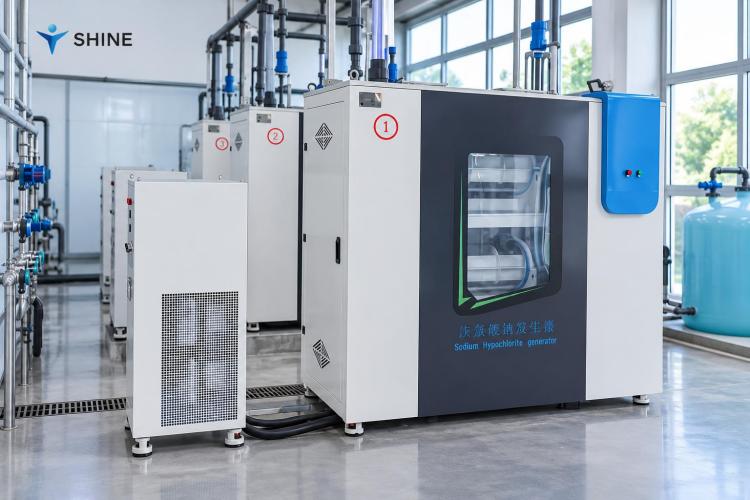
An On-site Sodium Hypochlorite Generator produces sodium hypochlorite at the treatment facility. The system typically uses salt, water, and electricity to generate a disinfectant solution.
For suitable water treatment applications, on-site generation offers several practical benefits:
Produces disinfectant close to the dosing point.
Reduces dependence on delivered sodium hypochlorite.
Supports continuous or automatic production.
Allows operators to control production according to demand.
Reduces the need to transport and store large amounts of commercial solution.
Shandong Shine Health provides on-site sodium hypochlorite generation solutions for water treatment applications. Our systems can help facilities manage disinfectant production and dosing more effectively. We recommend matching generator capacity and solution concentration to actual chlorine demand.
6. Operating Costs and Long-Term Performance
Initial equipment prices only show part of the investment. A complete comparison should include operating costs, maintenance, chemicals, electricity, labor, and replacement parts.
Conventional treatment often requires less energy and simpler equipment. However, chemical consumption and sludge handling can affect its total cost. Advanced treatment may require more electricity, membrane replacement, and skilled maintenance.
Before choosing a water treatment system, we suggest calculating:
Daily electricity consumption (kWh/day).
Chemical consumption (kg/day).
Water recovery rate (%).
Sludge production (kg/day).
Membrane replacement costs.
Labor and maintenance expenses.
Annual operating hours.
For disinfection systems, operators should also calculate daily available chlorine demand. This helps them select the correct generator output and avoid unnecessary production.
7. Final Thoughts: Choose Treatment Based on Water Quality
Conventional and advanced water treatment serve different purposes. Conventional treatment handles common particles and many basic treatment needs. Advanced treatment targets more difficult contaminants and supports demanding water reuse applications.
In practice, many facilities combine both approaches. They may use conventional treatment first, followed by membrane filtration, activated carbon, or other advanced processes. Disinfection then helps protect the treated water according to its intended use.
At Shandong Shine Health, we believe that reliable disinfection deserves careful attention. Our On-site Sodium Hypochlorite Generator helps water treatment facilities produce disinfectant where they need it. With the right system design, operators can improve process control and support stable water treatment performance.
Need a suitable on-site disinfection solution? Contact Shandong Shine Health to discuss your water treatment capacity, chlorine demand, and project requirements.