

Coagulation vs Flocculation Explained
Clean water starts with more than just filtration. Raw water often contains dirt, organic matter, bacteria, and tiny particles that resist natural settling. Removing these impurities requires several treatment processes, including coagulation and flocculation. Together, these two methods make treating water more efficient, reliable, and cost-effective.
At Shandong Shine Health, we believe that understanding each treatment stage helps operators achieve better water quality. From particle removal to final disinfection, every step matters. In this guide, we explore coagulation vs flocculation, their differences, and how they work together.
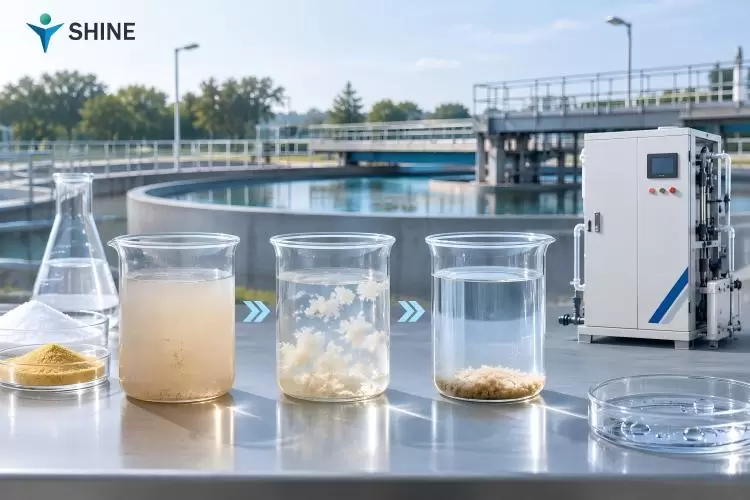
What Is Coagulation and Flocculation in Water Treatment?
Coagulation and flocculation are two closely related processes that help remove suspended impurities from water. Coagulation destabilizes tiny particles, while flocculation brings them together into larger clusters called flocs. These clusters become easier to remove through sedimentation or filtration. Both processes play essential roles in municipal and industrial water treatment.
What Does Coagulation Mean in Water Treatment?
Coagulation involves adding chemicals that reduce the electrical repulsion between suspended particles. Most colloidal particles carry a negative surface charge, which prevents them from sticking together. Coagulants introduce positively charged species that reduce this repulsion through charge neutralization. As a result, particles can begin to join together.
How Does Flocculation Work in Water Treatment?
Flocculation uses gentle mixing to encourage destabilized particles to collide and stick together. These collisions help particles grow, forming larger and heavier flocs. Unlike coagulation, this process requires slower mixing to protect fragile flocs. Eventually, many flocs settle to the bottom of a sedimentation tank.
Coagulation vs Flocculation: Key Differences
Although both methods remove fine particles, they serve different purposes. Coagulation changes the electrical conditions around particles, while flocculation promotes their physical growth. We can compare their main characteristics using the following table.
Parameter | Coagulation | Flocculation |
Main purpose | Particle destabilization | Floc formation |
Process | Chemical | Physical and chemical |
Mixing method | Rapid mix | Gentle mixing |
Typical duration | 10–60 seconds | 15–45 minutes |
Common chemicals | Alum, ferric chloride | Polymer aids |
Particle size | Small aggregates | Larger flocs |
Treatment sequence | First stage | Second stage |
Main mechanism | Charge neutralization and sweep coagulation | Particle collisions and bridging |
Actual operating parameters depend on water quality, chemical selection, and system design.
How Coagulation Works in Water Treatment
Coagulation begins when operators add a suitable chemical to raw water. A rapid mix system distributes the chemical throughout the water within seconds. Positively charged chemical species interact with negatively charged particles and reduce their electrical repulsion. This reaction creates favorable conditions for particle aggregation.
Common Types of Coagulants
Water treatment operators can choose from a wide range of chemical coagulants. Each chemical offers different benefits depending on water quality, pH, and operating costs. Common options include:
· Aluminum sulfate (alum): An economical choice for many conventional water treatment systems.
· Ferric chloride (FeCl₃): Effective across a relatively wide pH range.
· Polyaluminum chloride (PAC): A pre-hydrolyzed coagulant that can perform well under varying water conditions.
· Organic coagulants: Polymers with different molecular weights and charge density characteristics.
How Does Alum Work in Water Treatment?
Alum reacts with water and forms aluminum hydroxide, Al(OH)₃. Positively charged aluminum species help destabilize negatively charged particles. Aluminum hydroxide precipitates can also capture suspended impurities through sweep coagulation. Operators often target a pH range around 6.0–7.5, depending on treatment goals and water chemistry.
How Do Coagulation and Flocculation Work Together?
Think of coagulation as introducing strangers and flocculation as helping them form a group. Neither process achieves its full potential without suitable operating conditions. Together, they prepare suspended contaminants for removal during later treatment stages. A conventional water treatment facility typically follows this sequence:
Raw water → Coagulation → Flocculation → Sedimentation → Filtration → Disinfection
Understanding Zeta Potential and Particle Charge
Zeta potential describes the electrical potential near a particle's surface. A strongly negative value often indicates significant repulsion between particles. Coagulants reduce this repulsion by introducing species with a positive charge. However, effective coagulation does not always require a zeta potential of exactly 0 mV.
Why Mixing Speed Matters
Rapid mixing helps coagulants reach suspended particles before their reactions progress too far. Gentle mixing then allows flocs to grow without excessive damage. Too much mixing can break flocs apart, while insufficient mixing limits particle collisions. Finding the right balance helps operators ensure that impurities can be separated from the water efficiently.
What Causes Poor Coagulation and Flocculation in Water Treatment?
Even well-designed treatment systems can experience performance problems. Changes in raw water quality often affect chemical demand and floc formation. We recommend checking these common factors before increasing chemical dosage:
· Incorrect coagulant dosage
· Unsuitable pH or low alkalinity
· Excessive or insufficient mixing speed
· Low water temperature
· Inadequate flocculation time
· Incorrect polymer selection
· Sudden changes in turbidity (NTU)
Improve Performance With a Jar Test
A jar test helps operators determine suitable chemical doses under controlled conditions. Operators compare several water samples using different chemical concentrations, typically measured in mg/L. They then evaluate floc size, settling speed, and remaining turbidity. This simple and cost effective method helps reduce chemical waste and improve treatment efficiency.
Why Disinfection Matters After Flocculation
Coagulation and flocculation remove many suspended impurities, but they cannot guarantee microbiological safety. Harmful microorganisms may remain even when water looks perfectly clear. Therefore, effective disinfection remains essential for many drinking water and wastewater applications. Proper particle removal can also reduce chlorine demand and improve disinfection conditions.
On-site Sodium Hypochlorite Generator for Water Treatment
An On-site Sodium Hypochlorite Generator produces sodium hypochlorite (NaOCl) through the electrolysis of saltwater. This technology allows facilities to produce disinfectant directly at their treatment sites. It can reduce dependence on bulk chlorine deliveries and concentrated chemical storage. However, operators must still manage hydrogen ventilation, chemical dosing, and routine maintenance.
At Shandong Shine Health, we specialize in manufacturing on-site sodium hypochlorite generation equipment. Our focus is supporting reliable disinfection across different water treatment applications. Combining effective particle removal with controlled disinfection helps facilities achieve more consistent water quality.
Conclusion
Coagulation destabilizes suspended particles, while flocculation helps them grow into removable clusters. Both processes improve water clarity and prepare water for subsequent filtration and disinfection. Careful chemical dosing, regular jar testing, and proper mixing help maintain treatment performance. With suitable disinfection technology, facilities can build a more reliable and efficient water treatment system.