

How to Choose Water Treatment Pumps
Water pumps play a key role in every water treatment plant. They move raw water, transfer chemicals, supply filtration units, and deliver treated water. However, choosing the wrong pump can increase energy use, raise maintenance costs, and affect water quality.
At Shandong Shine Health, we understand that reliable equipment supports the entire treatment process. Pump selection should match the system design, water conditions, and daily operating needs. This guide explains how to select pumps for a water treatment system and avoid common design mistakes.
Understand the Pump's Role in a Water Treatment Plant
Before choosing a pump, we first need to understand its position in the treatment process. Different stages require different flow rates, pressure levels, and pump designs. A raw water pump may handle large volumes, while a chemical dosing pump needs accurate flow control. Therefore, one pump rarely suits every application.
A typical water treatment plant may use pumps for:
Raw water intake: Moves water from rivers, lakes, wells, or storage tanks.
Pre-treatment: Transfers water through screening and sedimentation units.
Filtration: Supplies pressure to sand filters, carbon filters, or membrane systems.
Chemical dosing: Adds disinfectants, coagulants, and pH adjustment chemicals.
Sludge handling: Transfers sludge during wastewater treatment processes.
Treated water delivery: Sends treated water to storage tanks or distribution networks.
Match the Pump to the Treatment Process
For example, a wastewater treatment plant handles suspended solids, organic matter, and sometimes fibrous materials. It often needs non-clogging pumps or submersible pumps. In contrast, a clean water supply system may use centrifugal pumps for stable water transfer.
Some wastewater treatment facilities also use pumps to circulate activated sludge. These applications require careful attention to solids content, viscosity, and operating conditions. We recommend selecting pumps according to actual process needs rather than choosing equipment by price alone.
Calculate Flow Rate and Pump Head
Flow rate and total dynamic head are two basic factors in pump selection. If either value is incorrect, the pump may fail to meet the system's requirements. An oversized pump wastes electricity, while an undersized pump cannot deliver enough water.
Determine the Required Flow Rate
Flow rate describes how much water a pump moves within a specific period. Common units include:
L/min: Liters per minute.
m³/h: Cubic meters per hour.
GPM: Gallons per minute.
For example, a treatment system that processes 100 m³/h needs pumps that support its required operating flow. However, engineers must also consider peak demand, future expansion, and standby equipment.
We suggest checking three operating conditions:
Minimum flow rate during low demand.
Normal flow rate during daily operation.
Maximum flow rate during peak demand.
Calculate Total Dynamic Head (TDH)
Pump head describes the energy required to move water through the system. Total dynamic head includes static lift, pressure differences, and friction losses.
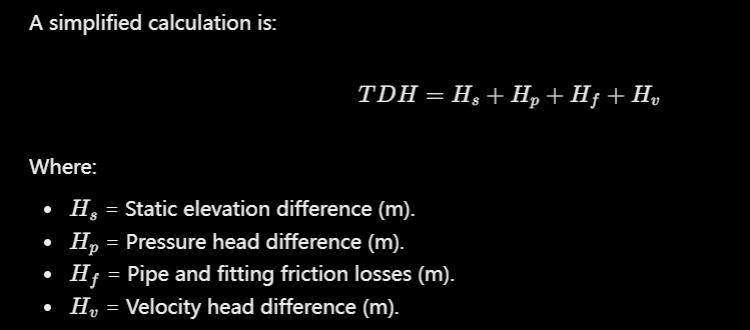
Engineers should also check the pump's net positive suction head (NPSH). The available NPSH must exceed the pump's required NPSH with an appropriate safety margin. This helps prevent cavitation, vibration, and damage.
The Hydraulic Institute explains how pump curves show flow, head, efficiency, power, and NPSH.
Choose the Right Pump Type
Different treatment system designs require different pump structures. We should consider water quality, installation conditions, pressure requirements, and maintenance access before making a decision.
Common pump types for water treatment:
Pump type | Typical application |
Centrifugal pump | Raw water and treated water transfer |
Submersible pump | Wastewater collection and drainage |
Diaphragm metering pump | Chemical dosing |
Peristaltic pump | Small-volume chemical transfer |
Multistage centrifugal pump | High-pressure filtration |
Progressive cavity pump | Sludge and viscous fluids |
Centrifugal Pumps for Water Transfer
Centrifugal pumps work well in many water supply and treatment applications. They offer stable flow, simple operation, and several capacity options. However, engineers must match the impeller, motor, and pump curve to actual system conditions.
Metering Pumps for Chemical Dosing
Chemical dosing requires accurate and adjustable flow. Diaphragm metering pumps often suit this task because they can deliver controlled chemical volumes under pressure. Material compatibility also matters when handling chlorine-based disinfectants, acids, or alkalis.
For an On-site Sodium Hypochlorite Generator, the dosing pump needs special attention. The system produces sodium hypochlorite on-site and supplies it to the required disinfection point. We recommend checking the solution concentration, chemical compatibility, dosing pressure, and required injection rate.
The pump must also support stable dosing during changes in water demand. A suitable metering pump and control system help maintain the target disinfectant dose.
Check Water Quality and Material Compatibility
Water quality directly affects pump performance and service life. Clean water, wastewater, seawater, and chemical solutions have different physical and chemical properties. Therefore, engineers should check the fluid before selecting pump materials.
Important factors include:
pH value: Acidic and alkaline liquids may attack certain materials.
Temperature: High temperatures can affect seals and pump components.
Chloride content: Chloride ions can increase corrosion risks.
Suspended solids: Sand and particles can cause wear or blockage.
Chemical concentration: Strong chemicals may damage unsuitable materials.
Viscosity: Thick liquids may require different pump designs.
For example, 316 stainless steel may suit many water applications. However, it does not resist every chemical or chloride condition. Plastic materials such as PVC, PP, and PVDF may offer better compatibility in selected chemical dosing applications.
We always recommend checking wetted materials, including the pump body, impeller, seals, and valves. A high-quality pump needs more than a strong motor. Every component must match the operating environment.
Consider Energy Efficiency and Operating Cost
A pump does more than move water. It also consumes electricity every operating hour. For this reason, operating cost should influence the initial selection.
A cost-effective pump should meet the required duty without unnecessary energy consumption. We recommend comparing the pump's efficiency, motor power, maintenance needs, and expected service life.
Select a Pump Near Its Best Efficiency Point
Every pump has a best efficiency point (BEP). This point represents the operating condition where the pump achieves its highest efficiency.
Running far from the BEP may increase vibration, noise, energy consumption, and mechanical stress. Therefore, engineers should review the manufacturer's pump performance curve before purchasing equipment.
Variable frequency drives (VFDs) can also help control flow according to changing demand. Instead of constantly restricting flow through valves, a VFD adjusts motor speed. This approach can reduce energy use in suitable systems.
Compare Long-Term Costs
The purchase price represents only one part of the total cost. We suggest calculating the following expenses:
Initial pump and motor investment.
Electricity consumption.
Routine maintenance.
Spare parts and replacement seals.
Downtime and repair costs.
Expected service life.
The U.S. EPA also highlights energy assessment and efficiency improvements for water and wastewater facilities.
A cheaper pump may look attractive today. However, higher electricity bills can quickly remove that advantage. We prefer equipment that delivers reliable performance over the long term.
Include Pump Selection in Treatment Plant Design
Good pump selection starts during the early engineering stage. It should not become an afterthought after engineers finish the pipes and tanks. Pump location, pipe diameter, installation height, and electrical supply all affect system performance.
How to Design a Water Treatment Plant
When engineers consider how to design a water treatment plant, they should first understand the water source and treatment goals. Then, they can develop the process flow diagram and select suitable equipment.
A typical design process includes:
Analyze raw water quality and daily water demand.
Define the required treated water quality.
Select suitable wastewater or drinking water treatment processes.
Calculate flow rates, pressure, and hydraulic losses.
Select pumps, pipes, valves, and treatment equipment.
Design electrical controls and monitoring systems.
Prepare equipment layouts and installation drawings.
Review safety, maintenance, and future expansion needs.
Engineering connects every part of a water treatment facility. It helps engineers coordinate hydraulic design, mechanical equipment, electrical systems, and process control.
For example, when engineers ask how to design a screening water treatment plant, they must consider screen capacity and the amount of collected debris. The upstream pump must deliver enough water without creating unnecessary hydraulic problems.
Likewise, engineers may use AutoCAD to prepare equipment layouts and pipe arrangements. However, knowing how to design a water treatment plant in AutoCAD does not replace hydraulic calculations or engineering checks. Drawings must reflect real equipment dimensions and actual operating conditions.
Engineers should also follow the applicable local design standards. The question "is code for design of water treatment plant" needs a location-specific answer. Different countries and regions apply different standards for water supply, wastewater treatment, electrical systems, and chemical handling.
Why Equipment Quality Matters
What does bad equipment do to water treatment? Poor pump selection can reduce flow, create unstable pressure, and interrupt chemical dosing. It may also increase leakage, corrosion, and maintenance frequency.
These problems can affect treated water quality and plant operation. In drinking water facilities, poor process control may also create risks to public health. We believe equipment reliability should remain a key part of every treatment plant design.
Plan for Reliable Operation and Maintenance
A water treatment system must operate reliably every day. Therefore, engineers should consider maintenance access and backup capacity before installation. A pump that performs well during testing may still create problems when operators cannot inspect or repair it easily.
We recommend checking the following points:
Standby pumps: Consider an N+1 arrangement for critical applications.
Automatic controls: Use level sensors, pressure switches, and flow meters.
Dry-run protection: Stop pumps when suction water becomes insufficient.
Overload protection: Protect motors against excessive electrical loads.
Leak detection: Monitor seals, connections, and chemical pipelines.
Maintenance access: Leave enough space for inspection and replacement.
Spare parts: Keep important seals, bearings, and other parts available.
For wastewater treatment systems, engineers should also check clogging risks and solids handling. Pumps that transfer sludge need suitable passages and structures. Regular inspection helps operators identify wear before a small issue becomes a major shutdown.
A reliable treatment system also needs clear operating records. We suggest recording flow rate, discharge pressure, power consumption, vibration, and maintenance history. These values help operators identify performance changes and improve water management.
Final Pump Selection Checklist
Before purchasing a pump, we recommend reviewing the following information with the equipment supplier.
Selection factor | Information to confirm |
Fluid type | Raw water, treated water, wastewater, or chemicals |
Flow rate | Minimum, normal, and maximum demand |
Pump head | Static head and total dynamic head |
Operating pressure | Required inlet and outlet pressure |
Fluid temperature | Minimum and maximum temperature |
Material | Pump body, impeller, seals, and valves |
Motor | Power, voltage, frequency, and efficiency |
Control | Manual, automatic, or VFD |
Installation | Horizontal, vertical, or submersible |
Maintenance | Inspection access and spare parts |
Backup | Standby pump and emergency operation |
At Shandong Shine Health, we believe every component should support the complete treatment process. Our On-site Sodium Hypochlorite Generator provides on-site disinfectant generation for suitable water treatment applications. When engineers select the associated dosing pump, they should match its capacity and materials to the required disinfection process.
The right pump does not simply move water from one place to another. It helps maintain stable flow, protect equipment, control operating costs, and support consistent water quality.
Our advice is simple: calculate first, compare carefully, and select for long-term performance. A well-designed pump system makes water treatment easier to operate and more cost effective.