

HOCl pH Guide: Why pH Controls HOCl
Why can two hypochlorous acid solutions with identical concentrations deliver different results? The answer often lies in their pH levels. Even a small pH change can influence antimicrobial activity, chemical stability, and disinfection performance. Understanding this relationship helps businesses make smarter decisions when producing and using HOCl.
At Shandong Shine Health, we specialize in manufacturing HOCl generators for different application needs. We believe that understanding water chemistry is essential for producing reliable disinfectant solutions. Concentration matters, but pH deserves equal attention. Our HOCl pH guide explains why pH controls the HOCl/OCl- balance.
What Is Hypochlorous Acid pH?
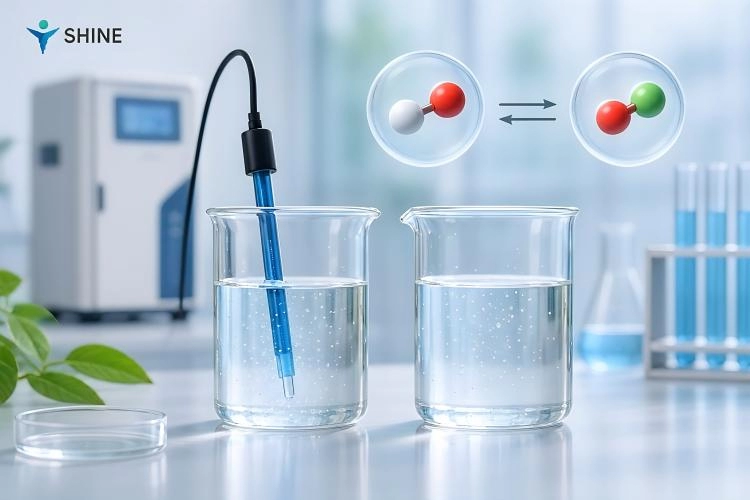
Hypochlorous acid (HOCl) is a weak acid with strong oxidizing properties. It also plays a natural role in the human immune system. The pH of hypochlorous acid solutions determines the balance between two major forms of free chlorine. These forms include hypochlorous acid and hypochlorite ions.
Understanding the HOCl/OCl- Balance
When HOCl dissolves in water, it establishes a chemical equilibrium. This reaction changes according to the pH of the solution. Lower pH generally favors HOCl, while higher pH favors the hypochlorite ion (OCl⁻). We can express this relationship through a simple chemical equation:
HOCl ⇌ H⁺ + OCl⁻
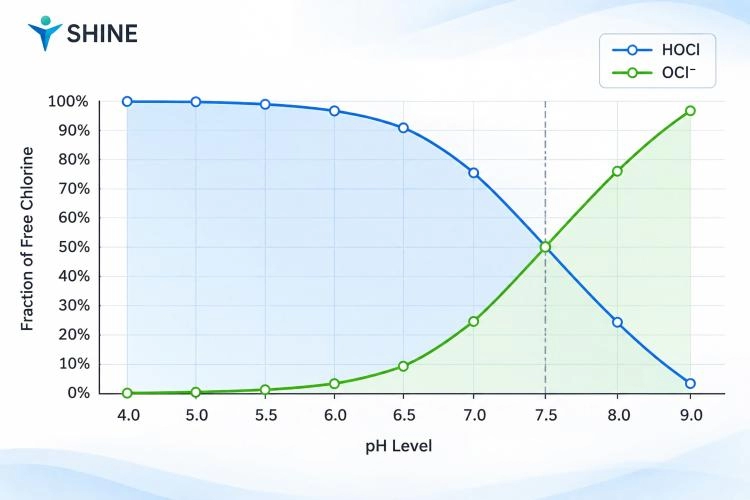
Hypochlorous acid has a pKa of approximately 7.5 at 25°C. At this point, HOCl and OCl⁻ exist in nearly equal amounts. Below this value, HOCl becomes more dominant. Above it, the proportion of hypochlorite ions increases.
How pH Changes HOCl Concentration
The following table illustrates the approximate distribution of free chlorine at different pH levels.
pH Level | HOCl | OCl⁻ |
4.0 | 99.97% | 0.03% |
5.0 | 99.68% | 0.32% |
5.5 | 99.01% | 0.99% |
6.0 | 96.93% | 3.07% |
6.5 | 90.91% | 9.09% |
7.0 | 75.97% | 24.03% |
7.5 | 50.00% | 50.00% |
8.0 | 24.03% | 75.97% |
9.0 | 3.07% | 96.93% |
These theoretical values assume a pKa of 7.5 and a two-species equilibrium. Temperature and water chemistry can influence the actual percentages. However, the trend remains clear. A small pH change can make a surprisingly large difference.
Why pH Affects HOCl Antimicrobial Activity
Many people assume that higher chlorine concentrations always provide better disinfection. However, the chemical form of chlorine also matters. HOCl generally offers greater antimicrobial activity than OCl⁻ under comparable conditions. Its electrical charge plays an important role in this difference.
How HOCl Attacks Microorganisms
HOCl carries no net electrical charge, while OCl⁻ carries a negative charge. This difference helps HOCl penetrate microbial barriers more readily. It can damage cell walls, cross the cell membrane, and oxidize essential proteins. These reactions disrupt vital functions and contribute to microbial inactivation.
HOCl vs. Hydrogen Peroxide
Both hypochlorous acid and hydrogen peroxide act as oxidizing agents. However, they differ in chemical behavior, stability, and application requirements. Their effectiveness depends on concentration, exposure conditions, and the target microorganism. We recommend selecting disinfectants according to validated performance rather than concentration alone.
What Is the Best pH Range for HOCl?
A pH range of 5.0–6.5 often provides a high proportion of hypochlorous acid. Many HOCl formulations target mildly acidic conditions for this reason. However, the ideal range depends on the intended application and formulation. We must also consider material compatibility, stability, and user safety.
Mildly Acidic pH vs. Neutral pH
At a neutral pH of 7.0, HOCl represents approximately 76% of the two chlorine species. At pH 5.5, this proportion rises to approximately 99%. However, extremely acidic conditions can increase the risk of chlorine gas formation. Never add acids to chlorine-containing solutions without a validated industrial process.
Does Lower pH Mean Greater HOCl Acid Strength?
The term HOCl acid strength often causes confusion among buyers. Hypochlorous acid remains a weak acid, regardless of its concentration. Its acid dissociation constant is approximately 3.2 × 10⁻⁸ at 25°C. Lower pH changes the chemical balance rather than the intrinsic acid strength.
HOCl 200 ppm vs. HOCl 500 ppm
Concentration provides another important measure of HOCl solution quality. Manufacturers often express free available chlorine concentrations in parts per million (ppm). Common examples include 200 ppm and 500 ppm HOCl solutions. However, buyers should confirm the measurement method and reporting basis.
HOCl 200 ppm: Lower-Concentration Applications
An HOCl 200 ppm formulation may support routine surface disinfection when its validated instructions permit. The appropriate contact time depends on the target microorganism and application conditions. Cleaning surfaces beforehand can reduce chlorine consumption from organic matter. We recommend following the specific HOCl product label for every application.
HOCl 500 ppm: Higher-Concentration Applications
A 500 ppm HOCl formulation contains more available chlorine than a 200 ppm formulation on the same measurement basis. Higher concentrations may suit certain validated commercial or industrial applications. However, they can also increase material compatibility concerns. More chlorine does not automatically guarantee better results.
Why pH and ppm Must Work Together
Consider two theoretical solutions with identical free chlorine measurement methods. Their pH values can create very different HOCl concentrations. The following comparison demonstrates this relationship. It assumes a pKa of 7.5.
Free Chlorine | pH | HOCl Fraction | HOCl Equivalent* |
200 ppm | 5.5 | 99.01% | 198 ppm |
200 ppm | 8.0 | 24.03% | 48 ppm |
500 ppm | 5.5 | 99.01% | 495 ppm |
500 ppm | 8.0 | 24.03% | 120 ppm |
*Values express the HOCl fraction on the same chlorine-equivalent reporting basis.
Interestingly, 200 ppm at pH 5.5 contains a greater HOCl fraction concentration than 500 ppm at pH 8.0. This comparison does not establish equivalent disinfection performance. Nevertheless, it highlights why pH monitoring matters.
How pH Influences HOCl Applications
Surface Disinfection and Contact Time
An HOCl surface disinfectant needs suitable concentration, pH, and contact time. Users should keep treated surfaces wet throughout the required exposure period. Porous surfaces may absorb liquids and create additional disinfection challenges. Always follow validated instructions for the relevant surface type.
Hypochlorous Acid in Wound Care
Certain medical-grade hypochlorous acid solution formulations support wound care and wound cleansing. These products require suitable purity, concentration, and tissue compatibility. Industrial disinfectants do not automatically meet medical requirements. We recommend using only products authorized for their intended medical applications.
How pH Affects HOCl Shelf Life
Hypochlorous acid can gradually lose available chlorine during storage. Heat, sunlight, impurities, and unsuitable packaging can accelerate this process. The pH of the solution also influences chemical stability. Therefore, manufacturers must balance antimicrobial performance with shelf life.
Practical Tips for Maintaining HOCl Stability
We recommend storing HOCl in compatible, tightly closed containers away from direct sunlight. Follow the manufacturer's temperature and storage instructions. Regularly measure pH and free chlorine to identify changes during storage. Product-specific stability testing should determine the actual expiration date.
How HOCl Generators Improve pH Control
HOCl generators use electrochemical processes to produce chlorine-based solutions. Reliable equipment helps operators manage production parameters and maintain consistent output. Important factors include water quality, electrolyte concentration, current, and flow rate. Regular monitoring helps operators identify unwanted changes.
At Shandong Shine Health, we focus on HOCl generator manufacturing and consistent production requirements. We understand that businesses need more than a high ppm reading. They also need practical control over solution quality and operating conditions. These factors support the production of safe and effective HOCl formulations for validated applications.
Conclusion
Hypochlorous acid pH plays a central role in chlorine chemistry and antimicrobial performance. A suitable pH range helps maintain a higher proportion of HOCl. However, concentration, contact time, storage, and application requirements also influence results. Successful disinfection requires these factors to work together.
At Shandong Shine Health, we believe reliable HOCl production starts with controlled chemistry. Our focus on HOCl generator manufacturing supports businesses exploring electrochemical disinfection solutions. Contact us to discuss your production requirements and suitable equipment options.