

How to Size an Ozone Generator for Water Treatment
What Is an Ozone Generator for Water Treatment?
When a facility needs clean water, choosing the right disinfection system matters. An undersized unit may fail to meet treatment goals, while an oversized unit can waste energy and money. At Shandong Shine Health, we believe every water treatment project should start with clear operating data and realistic targets.
So, what is ozone generator water treatment? It describes a process that uses ozone gas (O₃) to oxidize certain contaminants and help control microorganisms in water. Ozone acts as a powerful oxidizer, but its performance depends on water quality, ozone demand, mixing, and contact time.
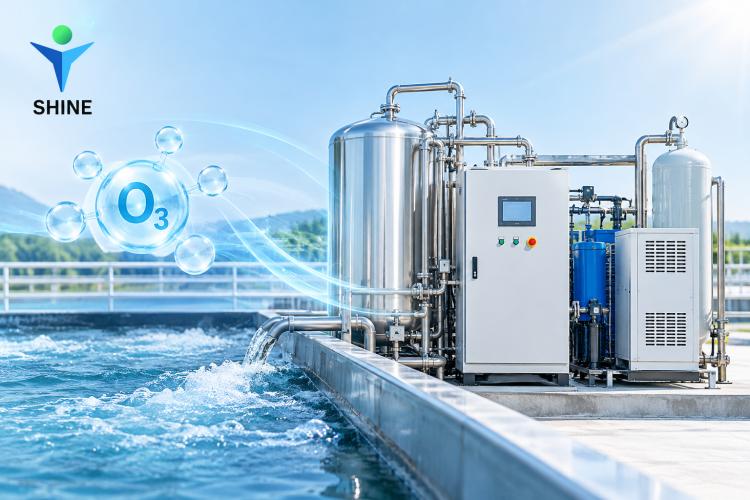
An ozone water treatment system usually includes an ozone generator, gas feed equipment, a contact tank, and off-gas destruction equipment. Operators must also monitor ozone output and protect workers from exposure. Good sizing connects these parts into one reliable treatment process.
How an Ozone Generator Works in Water Treatment
An industrial ozone generator creates ozone by converting oxygen into ozone molecules. Many commercial systems use corona discharge, which applies a high-voltage electrical field to oxygen-containing gas. This energy helps split oxygen molecules and form ozone (O₃).
The system then transfers ozone gas into water through an injector or diffuser. After mixing, ozone reacts with microorganisms and selected chemical contaminants. The remaining ozone breaks down over time, so engineers must design the process around actual treatment needs.
4. Calculate the Required Ozone Output
The first step in sizing an ozone generator involves measuring water flow and selecting a target ozone dose. Engineers express ozone output in grams per hour (g/h), while water flow often uses cubic meters per hour (m³/h). These values help estimate the generator's required capacity.
Use a Simple Ozone Sizing Formula
We can estimate the theoretical ozone requirement with this formula:
\[ \text{Ozone Output (g/h)} = \text{Flow (m³/h)} \times \text{Dose (mg/L)} \]
Because 1 m³ equals 1,000 liters, the units cancel into grams per hour.
For example, consider a facility that treats 20 m³/h and needs an applied dose of 3 mg/L. The theoretical requirement equals 60 g/h. However, the final generator may need higher output to account for ozone transfer losses and actual water demand.
Example: Ozone Generator Sizing
Illustrative calculation, not a final engineering specification.
Water flow
20 m³/h
Applied dose
3 mg/L
Theoretical ozone requirement
60 g/h
Final capacity depends on ozone demand, transfer efficiency, and operating conditions.
Account for Water Quality and Ozone Demand
Not all water needs the same ozone dose. Organic matter, iron, manganese, and other oxidizable substances can consume ozone before it reaches the target microorganisms. Therefore, we recommend testing the source water before choosing equipment.
For preliminary planning, engineers may examine these factors:
Water flow: Average and peak demand, measured in m³/h.
Ozone demand: The amount consumed by contaminants, measured through testing.
Transfer efficiency: The percentage of generated ozone that enters the water.
Water temperature and pH: Conditions that affect ozone reactions and stability.
Operating margin: Additional capacity for expected changes in water quality.
Avoid adding an arbitrary safety factor without technical support. Pilot testing offers a more reliable basis for final equipment selection.
5. Check Contact Time and Tank Volume
Ozone output alone cannot guarantee effective treatment. Water needs sufficient contact with dissolved ozone to achieve the required oxidation or disinfection results. Engineers must therefore size the contact tank alongside the generator.
Calculate the Required Contact Volume
A simple estimate uses this formula:
\[ V=Q\times t \]
Where:
\(V\) = effective contact volume (m³)
\(Q\) = water flow (m³/h)
\(t\) = contact time (h)
For example, a flow of 20 m³/h and a nominal contact time of 10 minutes gives a theoretical volume of approximately 3.33 m³. The actual tank may require more volume because internal equipment, flow patterns, and short-circuiting reduce effective contact.
Drinking-water systems often use contact periods of 10–20 minutes, but requirements vary by treatment objective. We recommend using validated design data rather than applying one contact time to every project.
6. Compare Ozone with Chlorine-Based Treatment
Ozone is a powerful disinfectant and strong oxidizer. It can help control microorganisms, reduce certain odors, and oxidize selected contaminants. However, ozone decomposes relatively quickly and does not provide a lasting disinfectant residual throughout a distribution network.
Compared to chlorination, ozonation can reduce the formation of some chlorinated by-products under suitable conditions. However, ozone can create other by-products, including bromate in water containing bromide. Operators should test source water and assess relevant regulations before selecting a treatment method.
When Should You Consider an On-Site Sodium Hypochlorite Generator?
At Shandong Shine Health, we focus on the On-site Sodium Hypochlorite Generator for facilities that need controlled chlorine-based disinfection. This approach produces sodium hypochlorite on-site for suitable water treatment applications. It can reduce reliance on transporting and storing large quantities of purchased solution.
Ozone may suit applications that need strong oxidation without a persistent ozone residual. Sodium hypochlorite may suit processes that require a measurable chlorine residual. Neither method fits every project, so we recommend comparing water quality, safety needs, operating costs, and treatment targets.
7. Review Safety, Costs, and Final Equipment Selection
An ozone water treatment system needs more than an ozone-producing unit. Ozone gas can harm workers when they inhale excessive concentrations. A complete design should include suitable ventilation, leak detection, off-gas destruction, and automatic shutdown controls.
To evaluate whether a system offers a cost-effective solution, calculate its full operating costs rather than its purchase price alone. Include electricity, oxygen supply, maintenance, spare parts, monitoring, and safety equipment. An eco friendly label or chemical free claim should never replace a practical review of energy use and by-products.
Before ordering an ozone generator for water disinfection treatment, confirm these details:
Water flow rate and peak demand
Required ozone dose and measured ozone demand
Target microorganisms or contaminants
Contact time and tank volume
Oxygen or dry-air supply requirements
Ozone transfer efficiency and residual monitoring
Off-gas treatment and worker safety controls
Total installation and operating costs
Our recommendation: Start with water testing, then calculate the theoretical ozone output. Next, validate the dose and contact time through pilot testing or reliable operating data. This process helps you choose a system that meets treatment targets without paying for unnecessary capacity.