

Primary vs Secondary Disinfection: Key Differences
What Is Disinfection in Water Treatment?
Clean water is not always safe water. It may contain harmful germs, even when it looks clear. At Shandong Shine Health, we believe safe drinking water starts with the right treatment process.
To define disinfection in water treatment, we can say it is the process of killing or inactivating harmful microorganisms. These include viruses and pathogenic bacteria. Without proper control, waterborne pathogens can spread disease and create serious health risks.
The purpose of disinfection in water treatment is to protect people from these dangers. However, one treatment step may not provide enough protection. Many water plants use primary and secondary disinfection to keep water safe from treatment to delivery.
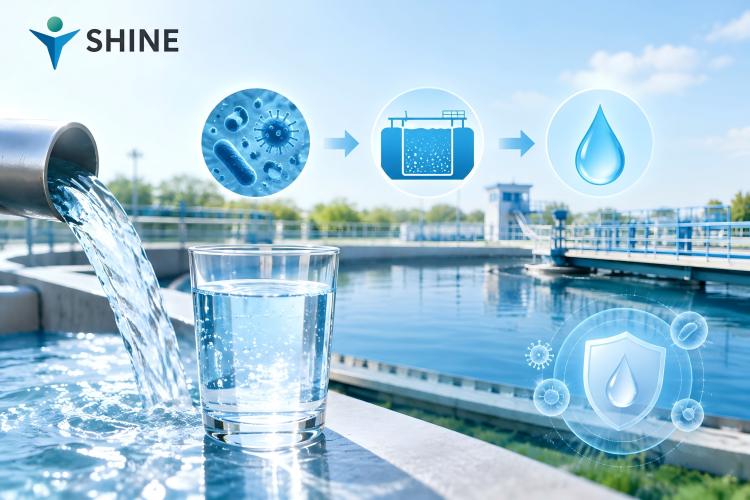
Primary vs Secondary Disinfection: Key Differences
Primary and secondary disinfection have different jobs. Primary disinfection controls germs during water treatment. Secondary disinfection helps protect water as it moves through pipes and storage tanks.
Feature | Primary Disinfection | Secondary Disinfection |
Main goal | Kill or inactivate germs | Maintain protection after treatment |
Main location | Water treatment plant | Storage tanks and pipe networks |
Main action | Reduce harmful microorganisms | Control microbial regrowth |
Common methods | Chlorine, UV, ozone | Chlorine, chloramine |
Key factor | Contact time and treatment performance | Residual disinfectant level |
Main benefit | Reduces immediate health risks | Helps protect water during delivery |
Both stages support protecting public health. However, they solve different problems. A good water treatment plan considers both stages from the beginning.
What Is Primary Disinfection Water Treatment?
Primary disinfection water treatment focuses on harmful microorganisms in treated water. Operators may use chemical disinfection, ultraviolet light, or ozone. They select the method based on water quality, plant capacity, and local rules.
Chlorine is a common primary disinfectant. It works as an oxidizing agent and damages important parts of microorganisms. With the right dose and contact time, chlorine can help kill pathogens and control harmful germs.
Operators must consider several factors:
Chlorine concentration: How much disinfectant enters the water.
Contact time: How long the disinfectant acts on the water.
pH level: How water chemistry affects chlorine performance.
Temperature: How water temperature affects the disinfection process.
Organic matter: Materials that may increase chlorine demand.
Water quality: Conditions that can affect treatment results.
For example, chlorine may react with organic matter and form disinfection by-products. Therefore, plants should improve water quality before disinfection whenever necessary.
What Is Secondary Disinfection Water Treatment?
Secondary disinfection water treatment helps maintain water quality after the main treatment stage. Water travels through pipes, tanks, and other equipment before reaching users. During this journey, germs may enter the system or grow again.
A residual disinfectant helps reduce this risk. It leaves some disinfecting power in the water after the initial treatment. Free chlorine and chloramine are common secondary disinfectants.
However, a chlorine residual does not guarantee completely safe water. Pipe leaks, poor maintenance, and long storage times can still cause problems. Operators should test water at suitable points across the distribution network.
Types of Disinfection in Water Treatment
Different water sources need different disinfection methods. The best choice depends on the target germs, water quality, cost, and operating conditions. Below are common types of disinfection in water treatment.
Common Disinfection Methods
Chlorine: Helps control germs and can provide a lasting residual.
Chloramine: Often supports secondary disinfection because it can remain in water longer.
Ultraviolet light (UV): Uses light to inactivate microorganisms without adding a chemical residual.
Ozone: Acts as a strong oxidizing agent and helps inactivate many microorganisms.
Chlorine dioxide: Provides another chemical option for suitable water treatment systems.
Each method has its own limits. UV does not leave a residual to protect water in pipes. Chlorine needs careful control because water quality affects its performance. Ozone can work well for primary disinfection, but plants may need another disinfectant for the distribution network.
Why Water Sources and Organic Matter Matter
Water sources can contain soil, organic matter, and other unwanted materials. These substances may affect disinfection performance. They can also increase chemical demand and change the final water quality.
For this reason, drinking water treatment often uses several water treatment processes. Filtration removes many particles before disinfection. Other treatment steps may address specific contaminants.
Operators should check raw water regularly. They should also adjust the process when seasons or source conditions change. Better control before disinfection can help improve the whole treatment system.
How to Choose an Effective Disinfectant
An effective disinfectant must match the plant's needs. Operators should consider water flow, target microorganisms, contact time, and local regulations. They should also review chemical costs, equipment needs, and daily maintenance.
Before selecting a disinfectant, we recommend checking these important parameters:
Parameter | What to Check |
Flow rate | Water volume treated per hour or day |
Dose | Required disinfectant amount |
Contact time | Time available for disinfection |
pH | Water acidity or alkalinity |
Turbidity | Cloudiness caused by particles |
Chlorine residual | Remaining disinfectant in the water |
Microbial tests | Results required by local rules |
For chlorine treatment, operators can use the CT concept:
CT = Chlorine concentration (mg/L) × Contact time (minutes)
For example, 1 mg/L of chlorine over 30 minutes gives a nominal CT value of 30 mg·min/L. This example does not prove that treatment is sufficient. Operators must confirm the required CT for the target microorganisms and actual water conditions.
They should also monitor disinfectant by-products. Correct dosing helps balance microbial control and chemical safety.
On-site Sodium Hypochlorite Generator for Water Treatment
An On-site Sodium Hypochlorite Generator makes sodium hypochlorite solution at the water treatment facility. The system uses salt, water, and electricity to produce a disinfectant solution. This approach can reduce the need to transport and store large amounts of prepared sodium hypochlorite.
At Shandong Shine Health, we provide generation solutions for suitable water treatment applications. A system can support primary disinfection, secondary disinfection, or both. The correct setup depends on the plant's dosing plan and water quality.
What Should Buyers Check Before Choosing a System?
We suggest checking these points before selecting equipment:
Chlorine output: Match production capacity to daily demand.
Solution concentration: Confirm the required available chlorine level.
Water flow: Calculate the disinfectant demand at peak flow.
Dosing control: Adjust dosing to match changes in water demand.
Safety design: Provide proper ventilation and hydrogen handling.
Maintenance: Check cleaning, inspection, and service requirements.
Monitoring: Measure chlorine residuals and check water quality regularly.
Chlorine gas also requires careful handling because it can cause serious harm. On-site sodium hypochlorite generation offers a different way to supply chlorine-based disinfectant. However, operators must still follow equipment instructions and local safety rules.
A well-designed system should connect production, dosing, and monitoring. This helps operators control the process and respond to changes in demand. It also makes daily operation easier to manage.
Why Is Disinfection Important in Water Treatment?
Why is disinfection important in water treatment? Because untreated or poorly treated water can carry germs that cause disease. Proper disinfection helps reduce these risks and supports safe drinking water supplies.
Primary disinfection helps control pathogens during treatment. Secondary disinfection helps protect water as it travels to homes, businesses, and public facilities. Together, these steps provide better protection than relying on only one stage.
However, disinfection cannot replace every other treatment step. Filtration, regular testing, and good pipe maintenance remain important. Operators must also control disinfectant levels and check for possible by-products.
At Shandong Shine Health, we believe the best solution starts with clear treatment goals. By choosing suitable disinfection methods and reliable generation equipment, water plants can improve control and support public health.
Conclusion
Primary and secondary disinfection perform different but connected roles. Primary disinfection targets harmful microorganisms during treatment. Secondary disinfection maintains protection during storage and distribution.
Both stages matter for reliable drinking water treatment. The right plan should consider water quality, disinfectant dose, contact time, and residual levels. An on-site sodium hypochlorite generator can support this plan when the plant's needs and operating conditions suit the technology.
At Shandong Shine Health, we focus on practical solutions for water treatment facilities. We recommend choosing equipment based on real demand, clear operating targets, and long-term maintenance needs.