

Hypochlorous Acid Formula Made Simple
When people first see the hypochlorous acid formula, chemistry can look intimidating. We prefer a simpler approach. HOCl is a small molecule, but it plays an important role in disinfection.
So, what is hypochlorous acid? It is a weak chlorine-containing acid that forms in water. Our bodies also naturally produce HOCl as part of the immune system.
For us, the interesting part is not just the formula. It is how the molecule behaves in water and why it can act as an effective disinfectant.
What Is Hypochlorous Acid?
The basic HOCl chemistry
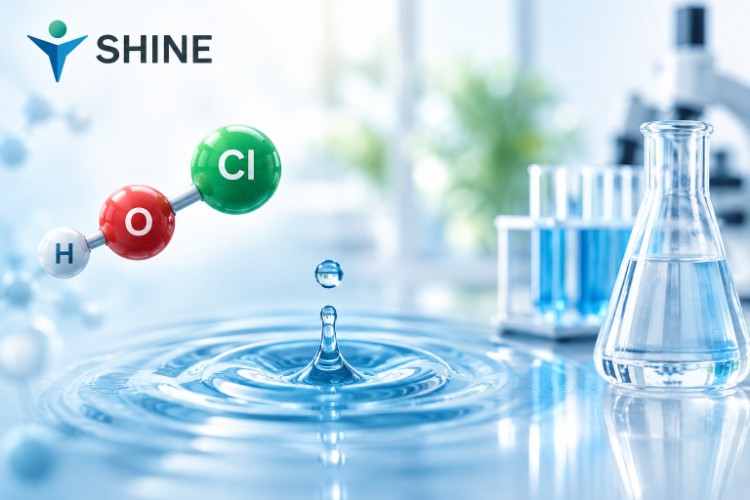
The hypochlorous acid chemical formula is HClO, also commonly written as HOCl. Both forms describe the same atoms:
H = hydrogen
O = oxygen
Cl = chlorine
Molecular weight ≈ 52.46 g/mol
CAS No. = 7790-92-3
PubChem lists HOCl as a weak and unstable chlorine oxoacid. It also identifies HOCl as the active form of chlorine in water.
In simple terms, the molecule contains one hydrogen, one oxygen, and one chlorine atom. That tiny structure helps explain why hocl acid behaves differently from many common cleaning chemicals.
HOCl is not chlorine gas
The word “chlorine” sometimes causes confusion. HOCl is not the same thing as chlorine gas. Chlorine gas has the formula Cl₂, while HOCl contains hydrogen, oxygen, and chlorine.
When chlorine chemistry enters water, several chlorine species can exist. HOCl represents one important form. The balance between HOCl and hypochlorite ion changes with pH.
How HOCl Forms in Water
From chlorine chemistry to HOCl
In water, chlorine chemistry involves several reactions. A simplified equation shows the key balance:
Cl₂ + H₂O ⇌ HOCl + H⁺ + Cl⁻
Another important reaction involves hypochlorite:
HOCl ⇌ H⁺ + OCl⁻
The second reaction matters because pH changes the amount of HOCl and OCl⁻ present. As pH rises, more HOCl converts into hypochlorite ion.
That is why we always pay close attention to pH level when designing or operating HOCl equipment. Chemistry is not just about making chlorine. It is about controlling the final water chemistry.
How generators produce HOCl
An HOCl generator uses electrochemical reactions to produce HOCl from water and a chloride source. Depending on system design, the feed solution can contain salt or another suitable chloride source.
This process creates electrolyzed water with controlled active chlorine. A well-designed system can adjust production according to the required concentration and flow.
For our systems, we focus on producing the solution on site. This approach lets users produce hypochlorous acid when they need it instead of depending on large volumes of stored solution.
Why pH Changes Its Chemistry
The HOCl and OCl⁻ balance
Think of HOCl and OCl⁻ as two forms of the same chlorine family. The ph range determines how much of each form exists.
The general relationship looks like this:
HOCl ⇌ H⁺ + OCl⁻
At lower pH values, the balance favors more undissociated HOCl. At higher pH values, more hypochlorite ion appears. CDC notes that chlorine's microbicidal activity largely comes from undissociated HOCl.
This relationship helps explain why pH control matters so much in practical disinfection.
How HOCl Helps Disinfect
What happens to microbes?
HOCl can interact with important structures in microorganisms. These include the cell wall, cell membranes, proteins, and other cellular components.
The molecule can cross microbial barriers and react with cellular materials. These chemical reactions can damage essential functions and help inactivate microorganisms.
That makes HOCl useful across a wide range of disinfection tasks. Research also continues to examine electrolyzed water for water safety and other applications.
Why concentration still matters
“Highly effective” does not mean that every HOCl solution works under every condition. Results depend on several parameters:
Available chlorine concentration
Contact time
pH
Organic load
Water quality
Target microorganism
Surface condition
Application method
For example, disinfecting surfaces requires enough contact time and suitable solution conditions. A quick spray followed by immediate wiping may not provide the same result as the validated contact time.
Hypochlorous Acid Uses
Common practical applications
The hypochlorous acid uses continue to expand across different industries. Depending on the product, regulations, and application, uses can include:
Food-processing environments
Commercial sanitation
Livestock facilities
Surface disinfection
Equipment sanitation
Water treatment
Healthcare-related applications
Our focus remains practical. We want customers to generate a controlled hypochlorous acid solution for their specific process.
Safety needs context
People often search for whether HOCl is safe for humans. We think the better question is: “Is this specific product safe for this specific use?”
A properly formulated product can support safe and effective applications. However, concentration, pH, purity, intended use, exposure route, and local regulations all matter.
We should also avoid assuming that every HOCl product has identical properties. Formulation and manufacturing conditions can change performance and stability.
Why Chemistry Matters for HOCl Generators
Turning a formula into a useful system
The formula HClO looks simple. The engineering behind stable production is not.
An HOCl generator must control several factors, including:
Feed-water quality
Chloride concentration
Electrical input
Electrolysis conditions
Production rate
Active chlorine concentration
pH
Temperature
Storage conditions
We believe this is where practical engineering matters most. A generator should not simply produce HOCl. It should produce a consistent solution that matches the customer's process.
For us, good HOCl equipment connects chemistry with real-world operation. The goal is simple: controlled production, predictable parameters, and convenient on-site use.
Final Thoughts on HOCl Chemistry
The hypochlorous acid formula may only contain three elements, but its chemistry has many practical details. HOCl forms part of chlorine chemistry in water and exists alongside other chlorine species.
The key idea is easy to remember: pH changes the balance, concentration affects performance, and contact conditions matter.
As an HOCl generator manufacturer, we focus on turning these chemical principles into reliable equipment. That helps users generate fresh HOCl solutions for applications including surface sanitation, food processing, livestock, and other commercial needs.