

UV Disinfection for Water Treatment: How It Works
When we talk about modern water treatment, ultraviolet light often sounds almost too simple. Put water under UV light, and harmful microorganisms become inactive. Yet a reliable system needs more than a lamp and a stainless-steel chamber.
We look at UV disinfection water treatment as one part of a complete treatment process. Water quality, flow rate, UV dose, filtration, lamp condition, and maintenance all matter. The right design can make UV a practical choice for drinking water and other water supplies.
What Is UV Treatment of Water?
How ultraviolet light disinfects water
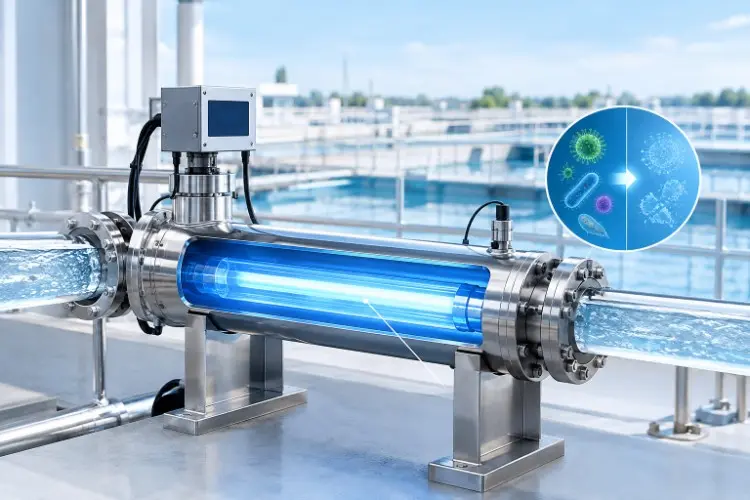
So, what is UV treatment of water? In simple terms, the process uses ultraviolet light to inactivate microorganisms as water passes through a treatment chamber.
UV light reaches microbial cells and damages their genetic material. This stops many bacteria, viruses, and protozoa from reproducing. As a result, the microorganisms lose their ability to cause infection.
A typical UV disinfection system uses a UV chamber, UV lamps, quartz sleeves, sensors, and control equipment. The water flows around the quartz sleeve while the lamp produces UV-C radiation.
UV treatment does not depend on adding a chemical directly to the water. However, the system still needs proper design and regular maintenance.
Why UV works without changing water chemistry
One reason we like UV technology is its simple treatment principle. UV light does not need to remain in the water after treatment.
It also does not aim to remove dissolved salts, heavy metals, or most chemical contaminants. Instead, its main job focuses on microbial control.
That distinction matters. A complete water filtration system may need several treatment steps before and after UV.
How UV Light Disinfection Works
UV dose, water flow, and exposure time
The key idea behind UV light disinfection water treatment is UV dose. Engineers commonly express UV dose as:
UV dose = UV intensity × exposure time
A common unit is mJ/cm².
The actual dose depends on several factors:
UV intensity
Water flow
Exposure time
Lamp output
Water quality
UV transmittance
Chamber design
Lamp age
Quartz sleeve condition
Water flow deserves special attention. If water moves too quickly, the system may not deliver the required dose. Therefore, we should always match the UV system with the actual water flow.
For example, a system designed for 5 m³/h should not automatically handle 20 m³/h. Bigger flow usually requires a different chamber or multiple UV units.
Why clear water matters
UV light needs a clear path through the water. Suspended particles can block or scatter the light before it reaches microorganisms.
This explains why many UV systems work better after filtration. The CDC also recommends filtration before UV treatment when water contains cloudiness or particles.
For this reason, we often consider UV part of a larger water treatment systems design rather than a stand-alone answer for every water problem.
UV Disinfection in Drinking Water Treatment
Targeting bacteria, viruses, and protozoa
UV disinfection in drinking water treatment can target a wide range of microorganisms. These include bacteria, viruses, and protozoa.
It can also play an important role against organisms such as Cryptosporidium and Giardia. These protozoa can create serious concerns for drinking water supplies. The EPA highlights Giardia and Cryptosporidium as important microbial pathogens in drinking-water treatment.
The exact performance depends on the organism, UV dose, water quality, and system design. Therefore, we should never judge a UV system only by its lamp wattage.
A better specification includes:
Parameter | Typical design concern |
Flow rate | m³/h or L/min |
UV dose | mJ/cm² |
UV intensity | Sensor-monitored |
UV wavelength | Commonly UV-C |
Lamp type | Low-pressure or other designs |
Water quality | Turbidity and UVT |
Chamber material | Stainless steel |
Sleeve | Quartz |
Control | Alarm and monitoring |
Where UV fits in the treatment process
A typical drinking water treatment process may include several steps:
Source water → Coagulation → Flocculation → Sedimentation → Filtration → UV or chemical disinfection → Distribution
Not every plant uses the same sequence. Source water quality determines the final design.
The CDC notes that water utilities may use UV light or ozone for disinfection. However, these methods do not provide continuing disinfection as water moves through distribution pipes.
This point can influence system selection. Some water plants may therefore combine UV with another disinfection method.
Main Parts of UV Systems
UV lamps and quartz sleeves
UV lamps provide the radiation that treats water. However, the lamp normally sits inside a protective quartz sleeve.
The quartz sleeve allows UV light to pass through while keeping water away from the electrical components. Over time, deposits can form on the sleeve. Even a good lamp cannot perform well when dirt blocks its light.
For this reason, we recommend regular inspection and cleaning. The CDC also notes that dirty tubes can reduce UV effectiveness.
Lamp replacement also matters. A lamp can still glow while its useful UV output has fallen. That is why serious UV systems use operating-hour records, sensors, or alarm functions.
Sensors and control systems
Modern UV disinfection systems often include:
UV intensity sensors
Flow sensors
Lamp status alarms
High-temperature protection
Automatic shutoff
Running-hour counters
Control panels
Data logging
These features help operators understand what happens inside the system. In our view, monitoring is far more useful than simply installing a powerful lamp and hoping for the best.
UV Disinfection Water Treatment Cost
What affects the total cost?
The uv disinfection water treatment cost depends on the application. A small point-of-use system and a municipal water plant have very different requirements.
Important cost factors include:
Required water flow
Required UV dose
Number of lamps
Chamber size
Pretreatment equipment
Control system
Installation
Electrical consumption
Lamp replacement
Quartz sleeve cleaning
Spare parts
Routine service
Energy use also depends on system size and operating conditions. Therefore, we should calculate cost from the actual flow and operating schedule rather than using one simple price per unit.
A useful calculation starts with:
Annual operating cost ≈ Energy + Lamps + Maintenance + Spare parts
That approach gives buyers a more realistic picture.
Does filtration increase the project cost?
Yes, sometimes. However, pretreatment can support more stable UV performance.
A water filtration system can reduce suspended solids before water reaches the UV chamber. This helps ultraviolet light travel through the water more effectively.
The CDC states that UV systems with pre-filtration work better than systems without pre-filtration.
Is UV Water Treatment Worth It?
When UV makes practical sense
So, is UV water treatment worth it? We believe it can be, when the system matches the water quality and operating needs.
UV can make sense for:
Drinking water facilities
Commercial buildings
Hotels
Hospitals
Food processing
Well-water treatment
Point-of-use systems
Industrial water supplies
Small community water systems
However, we should first understand the source water. UV does not solve every water problem.
It focuses on microbial disinfection. Other contaminants may require filtration, activated carbon, membrane treatment, chemical treatment, or another process.
When another treatment step may help
Cloudy water creates a major challenge for UV. High turbidity can reduce UV transmission and shield microorganisms.
That is why we recommend testing key water parameters before selecting UV systems. Useful parameters include:
Turbidity, UVT, flow rate, microbial load, temperature, iron, manganese, and hardness.
For larger projects, engineers should also consider peak flow instead of average flow. A system that works at normal flow may struggle during a sudden flow increase.
UV Systems vs. Complete Water Treatment
Building a reliable water supply system
We see UV as one tool within a larger water treatment strategy. A good system starts with the source and ends with safe water delivery.
Some plants use filtration followed by UV. Others combine UV with chemical disinfection. A Sodium Hypochlorite Generator can support on-site chemical disinfection where the plant requires controlled sodium hypochlorite production.
These technologies serve different process requirements. We recommend choosing the treatment method according to water quality, capacity, regulations, operating conditions, and the required disinfection process.
The goal remains simple: provide reliable water disinfection without making the plant unnecessarily complicated.
What should buyers check before purchasing?
Before choosing a UV disinfection system, we suggest checking these points:
Design flow: What is the minimum, normal, and peak flow?
UV dose: What dose does the application require?
Water quality: Is the water clear enough for UV?
Pretreatment: Does the water need filtration first?
Lamp life: How often should operators replace lamps?
Sleeve cleaning: Does the system offer easy maintenance?
Monitoring: Can operators see UV intensity and alarms?
Standards: Does the equipment meet the required local standards?
Backup: What happens if the UV unit stops?
Service: Can replacement parts arrive quickly?
The current NSF/ANSI 55 standard addresses UV microbiological water treatment systems and includes requirements for product information and service responsibilities.
Final Thoughts on UV Water Treatment
UV disinfection water treatment offers a clear and practical way to control microorganisms. Its success depends on more than ultraviolet light alone. Correct flow, sufficient UV dose, good pretreatment, clean quartz sleeves, and regular maintenance all play important roles.
We also believe buyers should avoid choosing equipment from lamp power alone. A well-designed system should match the actual water supply and treatment process.
For drinking water, industrial water, or commercial applications, the best approach starts with real operating data. Once we know the flow, water quality, and treatment target, we can select a system that makes technical and economic sense.
In short, UV can be an excellent part of modern water treatment. Just remember: even ultraviolet light needs a little housekeeping.