

Best Hypochlorous Acid Generator Commercial
Businesses today need a simple way to stay clean and safe. At the same time, they want to lower costs and reduce chemical use. That is why more companies now choose the Best Hypochlorous Acid Generator Commercial systems.
We have worked with customers from food factories, farms, hospitals, and cleaning companies. Many of them faced the same challenge. They needed a disinfectant that works well but does not create extra risks.
This is where hypochlorous acid, HOCl, stands out. It is powerful, safe, and easy to produce on-site.
Why Businesses Choose HOCl
Many cleaning products can kill germs. However, some contain strong odors or dangerous ingredients. Others can damage equipment over time.
HOCl offers a different solution. It forms naturally in human white blood cells. Our bodies use it to fight harmful germs every day.
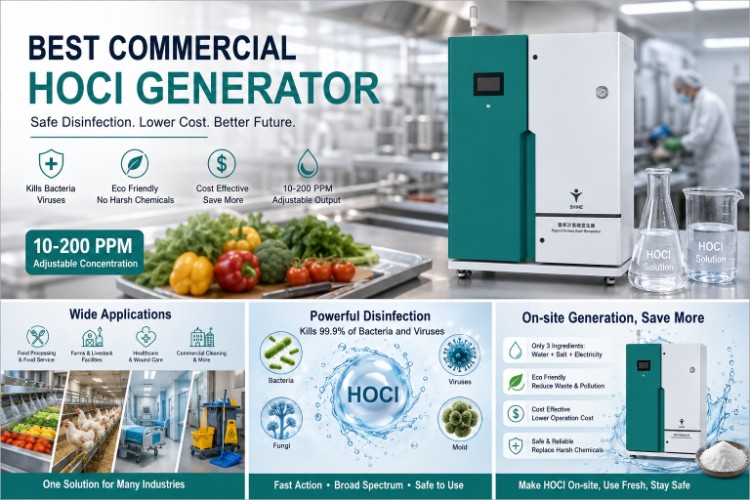
Today, modern hypochlorous acid generators can create the same substance from simple ingredients. The process uses water, salt, and electricity.
As a result, businesses can produce fresh disinfectant whenever they need it.
What Makes HOCl Different?
HOCl offers several important benefits:
Kills pathogens quickly
Works against many germs
Leaves little residue
Has a mild smell
Supports food safety programs
Reduces the need for harsh chemicals
Many users are surprised by how simple the process is. In fact, salt water is one of the main ingredients.
How Is HOCl Made?
The production process is easy to understand.
First, water and salt are mixed. Next, electricity passes through the solution. This process creates electrolyzed water that contains hypochlorous acid.
The quality of the final solution depends on:
Water quality
Salt purity
Current settings
Contact time
pH range
A stable pH range helps create more effective HOCl.
What Makes a Good Commercial HOCl Generator?
Not all systems perform the same way.
A good machine should produce stable concentrations every day. It should also be easy to operate and maintain.
When we help customers choose equipment, we recommend looking for these features:
Automatic controls
Easy monitoring
Durable components
Low maintenance
Energy efficiency
Adjustable concentration settings
These features help improve daily operations and reduce labor costs.
Why 10-200 PPM Output Matters
Different jobs require different concentrations.
A restaurant may need a lower concentration for daily cleaning. A livestock farm may need a stronger solution for disease prevention.
That is why many customers prefer systems with 10-200 PPM output.
Typical applications include:
Application | Recommended Level |
Hand-contact surfaces | 10-30 PPM |
Food preparation areas | 20-80 PPM |
Food service equipment | 50-100 PPM |
Farm facilities | 50-150 PPM |
Heavy contamination areas | 100-200 PPM |
This flexibility helps businesses use only what they need.
Where HOCl Is Used
One reason for the growing popularity of HOCl is its versatility.
The same system can support many different industries.
Food Processing and Food Service
Food safety remains a top priority.
Food factories and restaurants must control contamination every day. Even a small problem can lead to product recalls and financial losses.
Many businesses use HOCl to:
Clean and disinfect equipment
Sanitize work tables
Wash food contact surfaces
Reduce bacterial contamination
Because HOCl breaks down naturally, it is widely used in food environments.
Farms and Animal Facilities
Disease prevention is critical on farms.
Germs can spread quickly through equipment, housing, and water systems. Farmers need a disinfectant that works well without creating extra risks for animals.
HOCl helps:
Clean barns
Disinfect equipment
Sanitize water lines
Improve biosecurity
Many poultry and dairy farms now use HOCl as part of their daily cleaning program.
Hospitals and Healthcare Facilities
Healthcare facilities require strong infection control.
HOCl can help clean surfaces and equipment while reducing exposure to aggressive chemicals.
Many facilities appreciate that HOCl is gentle compared with some traditional disinfectants.
It is also widely recognized for use in wound care applications.
How HOCl Kills Germs
Many customers ask us the same question.
"Can it really kill germs effectively?"
The answer is yes.
Studies show that HOCl works against many types of microorganisms.
Effective Against Bacteria and Viruses
HOCl attacks germs quickly.
It can damage the protective layers around microorganisms. Once this happens, the germs can no longer survive.
This allows HOCl to help control:
Bacteria
Viruses
Fungi
Mold
Because of this broad action, many companies rely on HOCl for routine sanitation.
Faster Than Many Traditional Disinfectants
Time matters in commercial environments.
Workers cannot wait long periods for cleaning products to work.
Compared with some traditional disinfectants, HOCl often works very quickly. This helps businesses return equipment and work areas to service faster.
Less waiting means higher productivity.
Save Money and Protect the Environment
Many companies now look beyond cleaning performance. They also consider operating costs and environmental impact.
Fortunately, HOCl performs well in both areas.
Eco-Friendly Disinfection
More businesses want greener cleaning solutions.
Traditional chemical programs often require:
Plastic containers
Frequent deliveries
Large storage areas
Special handling procedures
HOCl changes that model.
Businesses can create disinfectant on-site using water, salt, and electricity. This reduces waste and transportation needs.
As a result, many companies view HOCl as an eco-friendly option.
Cost-Effective Operation
Chemical costs continue to rise.
Many businesses spend thousands of dollars each year on purchased disinfectants.
HOCl systems use inexpensive raw materials:
Salt water
Water
Electricity
This makes long-term operation highly cost-effective.
Many customers recover their equipment investment through lower chemical expenses.
How Long Does HOCl Last?
The shelf life of HOCl depends on storage conditions.
Freshly produced solutions usually provide the best performance.
Several factors affect shelf life:
Temperature
Light exposure
Container type
Concentration
pH stability
Proper storage helps maintain effectiveness longer.
Simple Storage Tips
We recommend these best practices:
Store in opaque containers
Avoid direct sunlight
Keep containers closed
Use a fresh solution when possible
Monitor concentration regularly
These steps help maintain solution quality.
How to Choose the Right Generator
Choosing the right system is important.
A machine that is too small may not meet production needs. A machine that is too large may increase costs unnecessarily.
Before buying, consider:
Daily output requirements
Desired concentration range
Available installation space
Maintenance needs
Technical support
The best HOCl generators offer reliable operation, simple controls, and consistent output.
Questions to Ask Before Purchasing
Before selecting a supplier, ask:
Can the system produce 10-200 PPM?
What is the daily production capacity?
How long do the electrodes last?
What maintenance is required?
Is technical support available?
Can the system support future expansion?
Clear answers help avoid future problems.
Conclusion
The demand for safe and effective disinfection continues to grow. Businesses need solutions that work without creating unnecessary risks.
The Best Hypochlorous Acid Generator Commercial systems provide a practical answer. They create powerful disinfectants from electrolyzed water, support food safety, reduce dependence on harsh chemicals, and help companies clean and disinfect more efficiently.
Whether you operate a food factory, restaurant, farm, hospital, or cleaning company, HOCl can help improve sanitation while lowering costs. With adjustable 10-200 PPM output, strong performance against bacteria and viruses, and environmentally responsible operation, it is becoming one of the most trusted disinfection solutions available today.
Frequently Asked Questions
Is HOCl safe around food?
Yes. Many food facilities use HOCl because it supports food safety programs and leaves very little residue when used correctly.
Can HOCl replace traditional disinfectants?
In many applications, yes. Businesses often use HOCl instead of several traditional disinfectants to simplify cleaning programs.
What ingredients are needed?
Most systems require only water, salt, and electricity.
Does HOCl have a strong smell?
No. HOCl usually has a mild chlorine-like smell that is much less noticeable than many chemical disinfectants.
Is on-site production better?
Many businesses prefer on-site production because they can make a fresh solution whenever needed and reduce storage requirements.