

Is HOCl a Strong Acid?
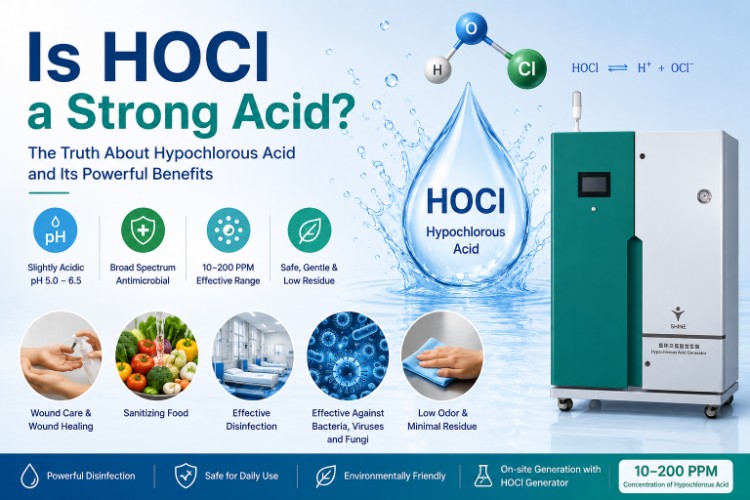
Many people ask us, "Is HOCl a Strong Acid?" The answer is simple: No, HOCl is not a strong acid.
Hypochlorous acid (HOCl) is a weak acid. However, it is still a very powerful disinfectant. This surprises many people. Most people think strong acids clean and disinfect better. In reality, that is not always true.
What makes HOCl special is its ability to kill germs while remaining gentle on people, animals, and many surfaces. It can help with wound care, food safety, and daily cleaning. It also leaves very few harmful residues behind.
In this article, we explain what HOCl is, why it is not a strong acid, and why it works so well for disinfection purposes.
What Is Hypochlorous Acid HOCl?
Hypochlorous acid, HOCl, is a natural substance. Our bodies make it every day.
When harmful germs enter the body, white blood cells produce HOCl. The body uses it as a defense tool to fight infection. This natural process is one reason why scientists trust HOCl.
Today, we can produce HOCl using water, salt, and electricity. The result is a disinfecting solution that works in many industries.
How HOCl Is Made
The process is simple:
Add salt water to a system.
Apply a small electric current.
The final product is usually slightly acidic electrolyzed water.
Many companies produce HOCl on-site because fresh solutions often perform best.
Is HOCl a Strong Acid?
No. HOCl is a weak acid.
Strong acids break apart completely when mixed with water. Examples include:
Hydrochloric acid (HCl)
Sulfuric acid (H₂SO₄)
Nitric acid (HNO₃)
HOCl behaves differently. Only part of the molecule breaks apart in water.
Because of this, scientists classify HOCl as a weak acid.
Why a Weak Acid Can Still Work Well
Weak does not mean ineffective.
For example:
Lemon juice is a weak acid.
Vinegar is a weak acid.
HOCl is a weak acid.
Yet HOCl can destroy many harmful microorganisms very quickly.
The reason is simple. HOCl can enter microbial cells easily. Once inside, it damages important cell structures and stops the organism from functioning.
This makes HOCl effective against a wide range of pathogens.
Understanding the pH Range of HOCl
The pH range of a solution affects how well HOCl works.
Most high-quality HOCl solutions have a pH level between 5.0 and 6.5.
This range helps keep more hypochlorous acid in the solution.
Why the pH Level Matters
The balance between HOCl and hypochlorite ion, OCl⁻ , changes as pH changes.
pH of the SolutionMain Form PresentBelow 5Mostly HOCl5.0–6.5High HOCl levelAbove 7.5More OCl⁻Above 9Mostly OCl⁻
The pH of the solution directly affects performance.
Lower pH values favor HOCl. Higher pH values create more OCl⁻.
Since HOCl works faster than OCl⁻, keeping the right pH level is important.
Why HOCl Has Strong Antimicrobial Properties
The biggest strength of HOCl is its excellent antimicrobial properties.
HOCl attacks germs in several ways at the same time.
It can:
Damage cell walls
Break down proteins
Stop enzyme activity
Disrupt normal cell functions
Because of these actions, HOCl acts as a broad-spectrum antimicrobial solution.
Effective Against Bacteria, Viruses and Fungi
Research shows that HOCl is effective against:
Bacteria
Viruses
Fungi
Yeast
Mold
In other words, it works against bacteria, viruses and fungi that commonly cause problems in homes, hospitals, farms, and food facilities.
Many users tell us that HOCl seems almost too good to be true. Fortunately, science supports its effectiveness.
Concentration of Hypochlorous Acid for Different Uses
The concentration of hypochlorous acid affects its application.
Most users work within the 10-200 PPM range.
Different jobs require different concentrations.
Common Concentration Guidelines
ApplicationRecommended ConcentrationSkin care10-50 PPMWound care20-80 PPMWound healing support20-80 PPMSanitizing food20-80 PPMSurface cleaning50-100 PPMEffective disinfection100-200 PPM
Choosing the right concentration helps achieve better results.
Using a higher concentration is not always necessary.
HOCl for Wound Care and Wound Healing
One of the most important uses of HOCl is wound care.
Since the human body naturally produces HOCl, it is often well-tolerated when used correctly.
Healthcare professionals use HOCl to help clean wounds and reduce harmful microorganisms.
Benefits for Wound Healing
HOCl may help:
Clean damaged skin
Reduce microbial contamination
Support healthy tissue
Improve patient comfort
These benefits make HOCl useful in many wound healing applications.
Many patients prefer gentle solutions. HOCl provides a balance between cleaning power and comfort.
HOCl vs Sodium Hypochlorite
People often confuse HOCl with sodium hypochlorite.
Although they are related, they are not the same.
Key Differences
FeatureHOClSodium HypochloritepHSlightly acidicAlkalineMain Active IngredientHOClNaOClOdorMildStrongSurface CompatibilityBetterLowerDisinfection SpeedFastModerate
The active ingredient in HOCl solutions is hypochlorous acid itself.
Sodium hypochlorite solutions can produce some HOCl under certain conditions, but they contain different chemistry.
For many applications, HOCl offers a more balanced solution.
Sanitizing Food with HOCl
Food safety is another major application.
Many processors use HOCl for sanitizing food and food-contact surfaces.
HOCl helps reduce microorganisms while leaving very little residue behind.
Benefits for Food Processing
HOCl can provide:
Fast microbial reduction
Low odor
Easy application
Effective disinfection
Fewer harmful residues
These advantages make HOCl popular in food production facilities around the world.
Consumers also prefer cleaning methods that leave fewer chemical traces on food.
Producing HOCl with an HOCl Generator
An HOCl Generator uses electricity to convert water and salt into hypochlorous acid.
The process creates slightly acidic electrolyzed water that can be used immediately.
Modern systems offer several benefits:
On-site production
Adjustable concentration
Fresh solution generation
Reduced chemical storage
Flexible disinfection purposes
Most systems can produce solutions within the 10-200 PPM range, depending on user requirements.
Conclusion
So, Is HOCl a Strong Acid? No.
HOCl is a weak acid with a slightly acidic pH. However, its performance is impressive. Thanks to its strong antimicrobial properties, it can act as a broad-spectrum antimicrobial solution.
HOCl is effective against a wide range of microorganisms, including bacteria, viruses and fungi. It also supports wound care, wound healing, food safety, and many other disinfection purposes.
When produced at the correct concentration of hypochlorous acid and proper pH range, HOCl delivers reliable cleaning and effective disinfection while leaving minimal harmful residues behind.