

HOCl Generator: System Architecture
How the HOCl System Works
When we design an HOCl Generator System Architecture: From Feedwater to Product Tank, we focus on one simple goal: stable production. The system must control water, salt, electricity, electrolysis, pH, concentration, and storage. Each part affects the final solution.
An hypochlorous acid generator uses water, salt, and electricity to produce an active chlorine solution. EPA describes hypochlorous acid generators as devices that can create electrolyzed water through physical means. In our view, good architecture matters more than adding unnecessary parts.
A typical process looks like this:
Feedwater → Water Treatment → Salt Solution → Electrolysis → HOCl Solution → Product Tank → Dosing Point
This simple path helps operators understand the complete system at a glance.
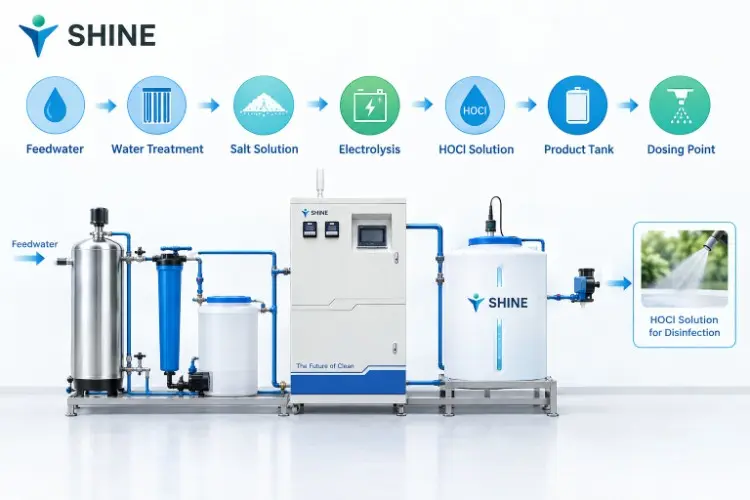
Feedwater Comes First
Clean and stable feedwater gives the system a better starting point. We normally check water quality, hardness, conductivity, temperature, and pressure before commissioning.
Typical design parameters may include:
Feedwater: clean process water
Pressure: according to equipment design
Temperature: stable operating range
Conductivity: suitable for electrolysis
Flow: matched to generator capacity
Small changes here can affect production. Therefore, we never treat feedwater as “just water.”
Water and Salt Preparation
The next stage prepares the electrolyte for the cell. Depending on the design, the system may use a saltwater solution or dilute hydrochloric acid as the electrolyte. Our system design can follow the selected electrolysis process.
Electrolyzed water research shows that low-voltage electrolysis can create HOCl-rich solutions under mildly acidic conditions. This explains why the front end needs stable water and electrolyte control.
Saltwater Solution and Dosing
For salt-based systems, operators prepare a controlled saltwater solution before electrolysis. The system then sends this solution toward the electrolytic cell at a controlled rate.
The basic concept remains easy to understand:
Salt + Water + Electricity → Electrolysis → HOCl-rich Solution
We like this design because the raw materials remain simple. It also supports on-site production instead of relying on large amounts of stored disinfectant.
The word “simple” matters here. A system should not become a chemistry puzzle just because it contains more pipes.
Inside the Electrolytic Cell
The electrolytic cell forms the heart of the system. Electrical energy drives reactions involving chloride ions and water. These reactions create active chlorine species, with HOCl becoming especially important at suitable pH levels.
The CDC notes that chlorine's antimicrobial activity comes largely from undissociated HOCl. It also explains that pH changes the balance between HOCl and hypochlorite ion, OCl⁻.
Producing Hypochlorous Acid
Our target is controlled hypochlorous acid HOCl, not simply “more chlorine.” A typical mildly acidic HOCl system may operate around pH 5.0–6.5, depending on its design and application.
Research on slightly acidic electrolyzed water also reports pH values around 5.0–6.5. At this range, HOCl represents a major active chlorine form.
This chemistry supports effective disinfection against a range of microorganisms. Studies describe activity against bacteria, viruses and fungi, although actual performance depends on concentration, contact time, organic load, temperature, and application conditions.
From Cell to Product Tank
After electrolysis, the generated solution moves toward the product tank. The tank gives operators a controlled point for short-term collection, monitoring, and use.
Concentration and pH Control
We usually pay close attention to two numbers:
pH: often designed within a mildly acidic range
FAC: commonly expressed in ppm
Flow: L/h or L/min
Production: L/h or batch volume
ORP: mV, when the application requires it
The required concentration depends on the application. For example, food processing uses different conditions from surface sanitation or other commercial tasks. FDA food-contact notifications show specific HOCl applications with defined free chlorine limits and use conditions.
We therefore recommend setting the generator around the real application instead of chasing one “perfect” number.
Why On-Site HOCl Production Matters
Many buyers search for terms such as hypochlorous acid machine, hypochlorous acid maker, or hypochlorous acid generator for home use. Commercial systems follow the same basic chemistry but require stronger process control, higher output, and more careful engineering.
Fresh, Controlled, and Cost Effective
A well-designed system can generate disinfectant close to the point of use. That reduces the need to transport large volumes of finished solution.
The process uses basic inputs such as salt water and electricity. This can make the approach cost effective and eco friendly for suitable applications.
HOCl also has an interesting biological connection. Our white blood cells, especially neutrophils, naturally produce HOCl during their antimicrobial response. That does not mean commercial HOCl works exactly like the immune system. However, the chemistry explains why researchers have studied it for antimicrobial use.
Designing a Reliable HOCl System
A good acid generator needs more than an electrolytic cell. We build the architecture around stable flow, electrical control, monitoring, safety, and easy maintenance.
Key System Components
A commercial system may include:
Feedwater inlet
Water filtration or conditioning
Salt or electrolyte preparation
Flow control
Electrolytic cell
Power supply
pH and FAC monitoring
Product tank
Transfer or dosing pump
Control cabinet
Safety sensors and alarms
These components work as one process chain. If one part drifts, the final product can also drift.
For this reason, we do not judge the best hypochlorous acid generator by the cell alone. We look at the complete architecture, control accuracy, output stability, service access, and application requirements.
The same principle applies when buyers search for the best hypochlorous acid machine. A machine should match the required flow, concentration, water quality, operating hours, and installation space.
From Product Tank to Real Application
The product tank acts as the final process point before use. Depending on the project, the system can send the solution directly to spraying, washing, dosing, or another application point.
Safe and Practical Operation
HOCl can serve as a powerful disinfectant, but “safe disinfectant” always depends on concentration, application, regulations, and correct operation. We never recommend using one setting for every task.
For commercial projects, we normally define:
Target concentration
Target pH
Required flow
Contact time
Daily production
Tank volume
Monitoring method
Cleaning schedule
Alarm limits
This approach makes the system easier to operate and validate.
The Architecture in One Line
In simple terms, our system follows this route:
Water → Electrolyte → Electrolysis → HOCl → Monitoring → Product Tank → Application
That is the core architecture behind modern HOCl generators. The system creates the disinfectant where the user needs it, while giving operators control over key parameters.
For us, the most important lesson is simple: good HOCl production starts long before the product reaches the tank. Stable feedwater, controlled electrolysis, accurate monitoring, and proper storage all work together. When those pieces fit, producing high quality HOCl becomes a much more predictable process.