

On-Site Hypochlorite Cost Guide
What Drives On-Site Operating Cost?
When we calculate the Operating Cost of an On-Site Sodium Hypochlorite System, we look at more than the machine price. Daily costs also include salt, electricity, water, maintenance, and labor.
A sodium hypochlorite system uses sodium chloride, water, and electricity to make disinfectant. A brine solution enters an electrolytic cell. The cell uses electrolysis to generate sodium hypochlorite on site.
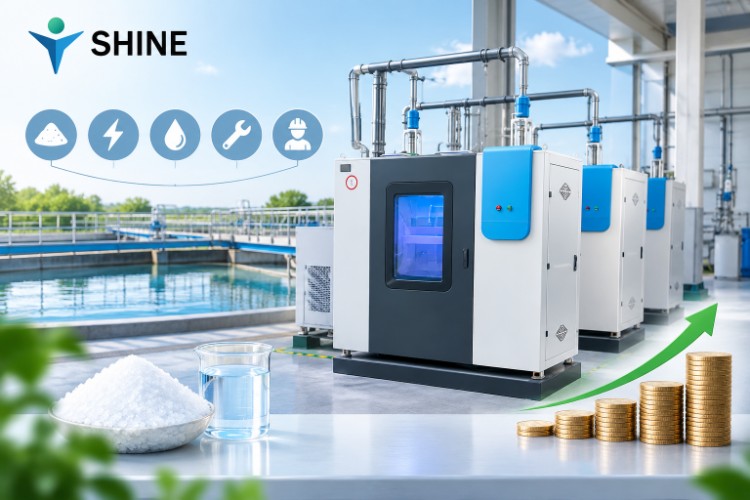
We normally check these values first:
Chlorine output: kg/h
Operating time: h/day
Salt use: kg/kg Cl₂
Power use: kWh/kg Cl₂
Water use: L/kg Cl₂
Electricity price: $/kWh
Salt price: $/kg
Maintenance: $/year
This simple data gives us a clear starting point.
A simple cost formula
We can use:
Daily cost = salt + electricity + water + labor + maintenance
We can also calculate:
Cost per kg Cl₂ = total daily cost ÷ daily chlorine output
This method helps us compare different systems fairly.
Salt and Electricity Costs
For most water treatment plants, salt and electricity make up a large part of operating costs. The exact cost depends on local prices and system design.
Salt consumption
The generator uses sodium chloride to make the brine solution. Salt consumption depends on the electrolytic cell and operating conditions.
For example, if a system produces 100 kg Cl₂/day and uses 3.5 kg salt/kg Cl₂, it needs:
100 × 3.5 = 350 kg salt/day
At $0.10/kg, the salt cost reaches $35/day.
We always recommend using the manufacturer's actual consumption data. One number cannot fit every system.
Electricity consumption
The system also needs electrical power. We calculate the cost with:
Power cost = kWh/kg Cl₂ × kg Cl₂/day × electricity price
For example:
2.5 kWh/kg × 100 kg/day × $0.10 = $25/day
A more efficient system can reduce long-term energy costs.
Water and Electrolytic Cell
Water use may look small. However, a large plant can operate 24 hours a day. Small differences can become large annual costs.
Good feed water also helps protect the equipment. Hard water may create deposits inside the system and increase cleaning needs.
Why the electrolytic cell matters
The electrolytic cell is the main working part of the generator. It converts the brine solution into sodium hypochlorite.
We normally monitor:
Cell voltage: V
Cell current: A
Water temperature: °C
Brine concentration: %
Product concentration: %
Product flow: L/h
Chlorine output: kg/h
Stable values help improve operational efficiency and cell life.
Storage and Dosing Costs
On-site generation still needs storage and dosing equipment. Most systems use a storage tank and dosing pumps.
The tank size depends on production, plant demand, and backup time. The flow rate also affects dosing requirements.
Sodium hypochlorite dosing system
A sodium hypochlorite dosing system should match the actual plant flow.
A basic calculation is:
Chlorine demand = water flow × chlorine dose
Automatic flow control can adjust dosing as water flow changes. This can reduce chemical waste and improve the disinfection process.
We also check pump capacity, standby pumps, sensors, injection points, and control systems.
Sodium hypochlorite solution
Fresh sodium hypochlorite solution needs suitable storage. Heat and long storage can reduce product strength.
On-site production can reduce the need to transport large amounts of finished chemical. It can also reduce long storage times.
Why Generate Sodium Hypochlorite On Site?
The main idea behind site sodium hypochlorite generation is simple. The plant makes disinfectant where it needs it.
Transport and chlorine gas
Transport can become expensive when a plant sits far from its chemical supplier. On-site production can reduce this cost.
Some plants also use the system as an alternative to chlorine gas handling. On-site generation can reduce the risk linked with transporting and storing chlorine gas.
However, safety remains important. Plants still need proper ventilation, electrical protection, chemical controls, and emergency procedures.
How We Calculate Cost Savings
We prefer a full life-cycle calculation. We do not compare equipment prices alone.
Five-year cost checklist
We normally review:
| Cost | Main factor |
| Salt | kg/year × salt price |
| Electricity | kWh/year × power price |
| Water | L/year × water price |
| Labor | Hours × labor rate |
| Maintenance | Parts + service |
| Storage | Tank and accessories |
| Dosing | Pumps and controls |
| Transport | Chemical delivery |
This approach works for water and wastewater treatment, industrial water systems, and other disinfection projects.
We can also review applications such as cooling towers and swimming pools. Each application needs its own dose and control plan.
Is On-Site Generation Cost Effective?
There is no single answer for every plant. Salt prices, electricity rates, water costs, flow rate, and operating hours all affect the result.
Still, the basic idea is clear. Generating sodium hypochlorite moves some costs from chemical delivery to local production.
For us, the most useful question is not only, “How much does the machine cost?” We also ask, “How much does each kilogram of available chlorine cost over its working life?”
A properly sized hypochlorite system can support better cost savings and operational control. It can also give treatment plants a more stable local supply of disinfectant.
At Shandong Shine Health, we start with real plant data. We review flow, chlorine demand, salt use, power use, storage, and dosing. Then we select the generation capacity around the actual process.
The goal is simple: use the right system, at the right capacity, with the lowest practical operating cost.