

Ozone vs Chlorine for Water Disinfection
Water needs proper disinfection before people can safely use it. Today, ozone and chlorine are two common choices. Both can kill harmful microorganisms, but they work in different ways.
We often see this question from water treatment projects: Which one should we choose? The answer depends on water quality, flow rate, treatment goals, and budget. In this guide, we explain the main differences in simple terms.
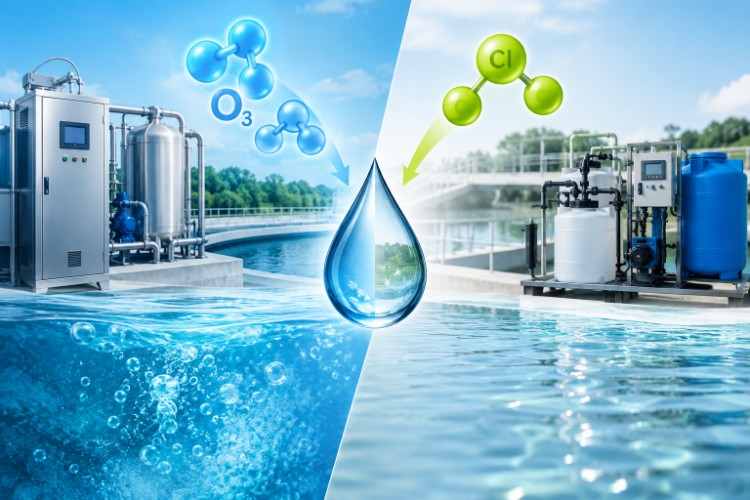
How Ozone and Chlorine Disinfect Water
How ozone water treatment works
Ozone uses O₃ to disinfect and treat water. It is a powerful oxidant and a highly reactive gas. When ozone enters water, it reacts with many substances.
The basic process is simple:
O₂ → O₃ → water contact → oxidation and disinfection
During this process, ozone attacks microorganisms and some organic compounds. It can also help reduce taste, odor, and color. Because ozone reacts quickly, many plants use it as part of an advanced treatment process.
However, ozone does not stay in water for a long time. This creates both a benefit and a challenge. The plant must control ozone concentration, contact time, and water quality.
How is ozone generated for water treatment?
Many people ask, how is ozone generated for water treatment? Most systems produce ozone on site. An ozone generator uses electricity to change oxygen into ozone.
A common method uses corona discharge. The generator passes oxygen or dry air through an electrical field. The energy splits some oxygen molecules. These molecules then form ozone.
The basic system usually includes:
Air or oxygen source
Air dryer
Ozone generator
Gas injector
Contact tank
Off-gas treatment unit
Control system
This method lets plants produce ozone when they need it. Operators do not need to transport large amounts of ozone because ozone has a short life.
Ozone Disinfection: Pros and Cons
Why do plants use ozone?
Ozone offers several useful benefits. First, it acts as a strong oxidizing agent. It can react with many contaminants and microorganisms.
Second, ozone works quickly under suitable conditions. It can support drinking water treatment and wastewater treatment. It can also improve taste and odor control.
Common benefits include:
Fast oxidation
Strong disinfection
No long-term ozone storage
On-site ozone production
Taste and odor control
Color reduction
Support for advanced treatment
Useful wastewater treatment applications
We especially like ozone when a project needs more than simple disinfection. Ozone can serve several roles in one treatment train.
What are the limits of ozone?
Ozone also has some clear limits. First, ozone systems need electricity. Large systems can have high power demand.
Second, ozone equipment needs careful control. Operators must monitor ozone concentration and contact conditions. The system must also handle unused ozone gas safely.
Another key issue involves residual protection. Ozone breaks down quickly. Therefore, it does not provide the same long-lasting residual as chlorine.
For this reason, some plants use another disinfectant after ozone. This extra step can increase equipment and operating costs.
Chlorine Disinfection: Pros and Cons
Why does chlorine remain popular?
Chlorine has a long history in water disinfection. It remains one of the most widely used disinfectants. Operators understand the process well.
Chlorine can also leave a disinfectant residual in treated water. This residual can continue to protect water inside pipes and storage tanks.
Chlorine can enter a treatment plant in several forms:
Chlorine gas
Sodium hypochlorite
Calcium hypochlorite
On-site generated sodium hypochlorite
For many modern projects, we prefer on-site generation when chemical transport creates extra problems.
A Sodium Hypochlorite System can produce sodium hypochlorite close to the point of use. This can reduce the need to transport and store large amounts of commercial solution.
What are the limits of chlorine?
Chlorine also needs careful control. The correct dose depends on water quality, pH, temperature, and contact time.
Chlorine can react with natural organic matter in water. These reactions may form disinfection by-products. Therefore, plants must control both the chlorine dose and water chemistry.
Too little chlorine can reduce disinfection performance. Too much can create taste, odor, and corrosion concerns. Good dosing control matters.
Ozone vs Chlorine: Cost and Operation
Which option costs less?
There is no single answer. The total cost depends on the size and design of the treatment system.
Ozone usually needs more equipment. It also needs electrical power and off-gas control. Therefore, its initial cost can be higher.
Chlorine systems often have simpler equipment. However, chemical purchase, transport, storage, and safety costs can add up.
We recommend checking the total cost of ownership instead of looking only at the equipment price.
Consider these factors:
Factor | Ozone | Chlorine |
Main action | Strong oxidation | Disinfection and oxidation |
Residual | Very low | Yes |
Generation | On site | On site or delivered |
Power demand | Higher | Usually lower |
Equipment | More complex | Simpler |
Taste and odor control | Strong | Limited |
Distribution protection | Limited | Strong |
Chemical storage | Low | Can be needed |
Operating skill | Higher | Moderate |
Typical cost | Higher initial cost | Often lower initial cost |
The lowest purchase price does not always mean the lowest operating cost. Energy, maintenance, labor, chemicals, and safety all matter.
Philadelphia Water Treatment Plant Ozone Disinfection
Why is Philadelphia important?
The phrase philadelphia water treatment plant ozone disinfection often appears in searches about large-scale ozone treatment. Philadelphia has used ozone technology in its water treatment system as part of its approach to drinking water quality.
This example shows why ozone can work well in large treatment plants. Large plants can use ozone to support oxidation and disinfection. They can then use other treatment steps to provide additional protection.
For engineers, the main lesson is simple. A large water plant does not depend on one treatment step. It often combines several treatment processes.
A typical treatment train may include:
Coagulation → filtration → ozone → biological treatment → filtration → final disinfection
The exact process depends on raw water quality and project requirements.
Common Applications of Ozone and Chlorine
Where does ozone work best?
An ozone generator for water disinfection treatment can serve many applications. Municipal drinking water is one major use.
Ozone also supports:
Industrial water treatment
Wastewater treatment
Aquaculture
Advanced oxidation
Taste and odor control
Color control
Process water treatment
Selected contaminant removal
Ozone works especially well when the project needs strong oxidation. It can help purify water while supporting microbial control.
Where does chlorine work best?
Chlorine remains a strong choice for many water systems. It works well when the system needs a lasting disinfectant residual.
Common uses include:
Drinking water
Municipal water networks
Storage tanks
Industrial water
Process water
Distribution systems
Emergency disinfection
An on-site Sodium Hypochlorite System can also help plants produce disinfectant when needed. This approach can improve chemical supply and dosing control.
How Should We Choose?
Start with the raw water
We always recommend testing the water before choosing a disinfectant. Water chemistry can change treatment performance.
Important factors include:
Turbidity
pH
Temperature
Organic matter
Ammonia
Bromide
Microbial levels
Water flow
Required contact time
For ozone, we need to understand the ozone demand. Other substances can consume ozone before it reaches the target.
For chlorine, we need to understand chlorine demand and pH. These factors affect the available disinfectant.
Look at the whole treatment system
We should also consider the complete treatment system. The best solution must fit the full process, not just one treatment step.
Ask these questions:
What microorganisms must we control?
Do we need oxidation as well?
Do we need a disinfectant residual?
What flow rate must we treat?
How much power can we use?
Can we store treatment chemicals safely?
What local rules apply?
What are the long-term operating costs?
These questions make the selection much easier.
Final Thoughts
Ozone and chlorine both have an important role in water disinfection. Ozone acts as a powerful oxidant and works quickly. It also supports taste, odor, and organic matter control.
Chlorine offers reliable disinfection and a useful residual. It remains a practical option for many drinking water systems. An on-site Sodium Hypochlorite System can also simplify chemical supply.
In our view, the best answer is not always ozone or chlorine. Sometimes the best design uses both technologies. Good water treatment starts with the water itself, then builds the right treatment process around it.