

Water Treatment Plant Design Basics
When we design a water treatment plant, we never start with equipment alone. We start with the water, the required capacity, and the final water quality target. These three factors shape almost every design decision.
A good plant should handle normal flow, peak flow, and future demand. It should also remove the right contaminants without making the system too complex. In our experience, simple and well-balanced designs often perform better than oversized systems.
So, what is a water treatment plant? In simple terms, it is a group of processes that treat water and make it suitable for a specific use. That use may involve drinking, industry, irrigation, or environmental discharge. WHO also stresses that water safety depends on risk management from the source to the consumer.
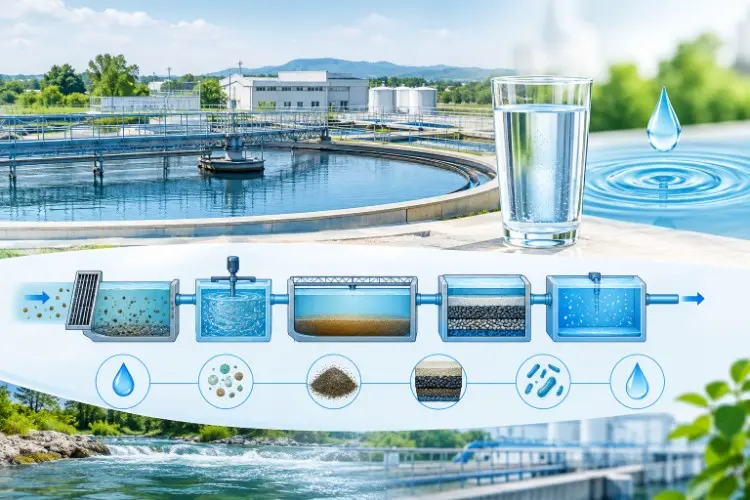
What Does a Water Treatment Plant Do?
A water treatment plant uses several treatment steps to remove contaminants from raw water. These contaminants may include suspended solids, microorganisms, metals, organic matter, and unwanted chemicals.
What Is a Water Treatment Plant?
When people ask what does the water treatment plant do, they often expect one simple answer. However, a plant can perform many jobs at once. It can clarify water, reduce harmful substances, control microbes, and improve taste or odor.
The design depends heavily on the source. Surface water often contains more suspended particles and organic materials. Groundwater may contain higher levels of iron, manganese, or dissolved minerals.
For example, a typical drinking water treatment process may include:
Screening
Coagulation
Flocculation
Sedimentation
Filtration
Disinfection
pH adjustment
Storage and distribution
EPA describes filtration, flocculation, sedimentation, and disinfection as common processes for surface water systems.
What Are the Steps of a Water Treatment Plant?
The answer to what are the steps of a water treatment plant depends on raw water quality. Still, most conventional systems follow a logical treatment train.
First, screens remove large debris. Next, chemical dosing helps small particles form larger flocs. A sedimentation tank then allows these particles to settle.
After clarification, filters remove finer particles. Finally, disinfection controls microorganisms before the treated water enters storage or distribution.
Start With Capacity and Flow
Capacity represents how much water the plant must handle. Designers normally express flow as m³/h, m³/d, L/s, or MGD.
Calculate Average and Peak Flow
We recommend calculating several flow values instead of using one number.
A basic design set may include:
Average flow: Qavg
Maximum daily flow: Qmax,d
Peak hourly flow: Qpeak,h
Future design flow: Qfuture
For example, a plant may receive 10,000 m³/day on average. Its peak demand could reach 15,000 m³/day. Designing only for 10,000 m³/day could create problems during high-demand periods.
Peak flow also matters in wastewater treatment facilities. EPA notes that wet-weather inflow and infiltration can push flows beyond existing treatment capacity.
Allow Room for Future Growth
We rarely recommend designing a plant only for today's demand. Population, industrial processes, and water use can change quickly.
A simple planning formula looks like this:
Qfuture = Qcurrent × (1 + growth rate)ⁿ
Here, n represents the planning period in years.
Engineers should also consider equipment redundancy. One failed pump should not stop the whole plant. Reliable designs often include standby pumps, parallel filters, and multiple treatment basins.
Build the Right Treatment Train
A treatment train connects several unit processes in sequence. Each stage solves a different water quality problem.
Primary Treatment and Clarification
In wastewater systems, primary treatment mainly removes settleable and floating solids. A primary sedimentation tank uses gravity to separate these materials.
The next stage often provides secondary treatment. Biological processes use microorganisms to reduce biodegradable organic matter and suspended solids. An aeration tank often supplies oxygen for this biological activity.
EPA identifies screening, primary clarification, secondary biological treatment, and disinfection as common municipal wastewater steps.
Coagulation, Flocculation, and Filtration
Drinking water systems often use coagulation before sedimentation. Chemicals neutralize particle charges and help small particles form larger flocs.
Ferric chloride provides one common coagulation option. Alum, polymers, and other coagulants can also serve specific water conditions. However, operators should select chemicals through jar testing and water quality analysis.
The basic sequence looks like this:
Raw water → Coagulation → Flocculation → Sedimentation → Filtration → Disinfection
This sequence works well because each stage prepares water for the next one. EPA also explains that coagulation and flocculation help remove inorganic and organic colloidal materials.
Design Around Water Quality
Water quality should drive the treatment process. We should never select equipment first and test the water later.
Test the Raw Water First
A proper raw water survey should include key parameters such as:
Parameter | Common concern |
Turbidity | Suspended particles |
pH | Chemical control |
TSS | Solids loading |
COD | Organic pollution |
BOD | Biodegradable organics |
Ammonia | Nutrient pollution |
Iron | Color and deposits |
Manganese | Color and taste |
Microbes | Health risk |
Hardness | Scaling |
TOC | Organic carbon |
The final target depends on the application. Drinking water treatment needs much tighter health controls than many industrial applications.
WHO's current guidance emphasizes health-based targets, risk management, and surveillance for drinking-water quality.
Match Each Contaminant to a Process
Different contaminants require different barriers. A filter cannot solve every problem. Likewise, disinfection cannot remove heavy metals or most dissolved salts.
For example:
Turbidity → coagulation and filtration
Suspended solids → sedimentation
Organic matter → biological treatment or adsorption
Iron → oxidation and filtration
Hardness → softening
Pathogens → disinfection
Dissolved salts → membranes or ion exchange
This approach makes the treatment train easier to understand and operate.
Chemical and Disinfection Design
Chemical systems deserve special attention because dosing errors can affect the whole plant.
Control Dosing and Contact Time
Operators should control chemical dosing according to flow and water quality. A basic dosing relationship is:
Chemical dose (mg/L) = mass rate (mg/min) ÷ flow (L/min)
The actual dose should come from testing, regulations, and process requirements.
For disinfection, contact time matters too. Designers often consider CT, where:
CT = disinfectant concentration × contact time
A sodium hypochlorite system can provide on-site disinfectant for water and wastewater applications. Our approach at Shandong Shine Health focuses on on-site generation and controlled dosing. This can reduce reliance on bulk chemical transport and simplify supply management.
We also recommend monitoring pH because chlorine chemistry changes with pH. Good control helps maintain stable disinfection performance.
Wastewater Plants Need Extra Planning
Not every water treatment plant cleans water for drinking. Many plants treat wastewater before discharge or reuse.
How Wastewater Treatment Processes Differ
Typical wastewater treatment processes may include:
Preliminary screening
Grit removal
Primary treatment
Secondary treatment
Tertiary treatment
Disinfection
Sludge treatment
Secondary biological treatment often needs careful oxygen control. The aeration tank can consume significant energy, so poor airflow control can increase operating costs.
Advanced treatment may target nitrogen, phosphorus, pathogens, or trace contaminants. Therefore, treatment plants include different technologies based on the discharge or reuse target.
Design for Reliable Daily Operation
A technically correct plant can still fail if operators cannot manage it easily. We believe practical operation should guide design from the beginning.
Add Monitoring and Backup
A reliable design should monitor important points across the treatment train.
Useful instruments include:
Flow meters
pH sensors
Turbidity meters
Pressure gauges
Level sensors
Residual disinfectant analyzers
Dissolved oxygen sensors
Conductivity meters
Automation can connect these measurements to alarms and control systems. However, we still recommend manual checks. Sensors can fail, and water has a funny habit of ignoring our spreadsheets.
Think About Energy and Sludge
Energy use can become a major operating cost. Pumps, blowers, mixers, and membrane systems all consume power.
Sludge also needs a clear management plan. Primary and biological treatment can produce significant solids. Designers should consider thickening, dewatering, storage, transport, and final disposal.
EPA guidance for reliable reuse systems also highlights redundancy for pumps, filters, basins, and other critical units.
A Practical Design Checklist
Before finalizing a project, we suggest checking these points:
Raw water source and seasonal changes
Average and peak flow
Future capacity
Required water quality
Target contaminants
Treatment train
Chemical selection
Disinfection method
Hydraulic loading
Tank volume
Retention time
Filter loading rate
Pump duty and standby capacity
Sludge production
Energy consumption
Instrumentation
Maintenance access
Safety requirements
Expansion space
The key idea is simple: design the process around the water, not around a machine catalog.
Final Thoughts on Plant Design
So, what water treatment plant design works best? We believe the answer depends on three foundations: water quality, flow, and treatment goals.
A good plant balances capacity with process performance. It uses the right treatment train and leaves enough flexibility for future changes. It also protects operators from unnecessary complexity.
For drinking water, wastewater, and industrial processes, the same principle applies. First understand the water. Then define the target. Finally, select and connect the treatment processes that can reliably achieve it.
A well-designed plant should quietly do its job every day. When operators barely notice the system, we usually consider that a good sign.