

Is HOCl polar or nonpolar?
Hypochlorous acid looks like a simple chemical. Its formula is HOCl. But this small molecule has useful chemical properties. One common question is: Is HOCl Polar or Nonpolar?
The answer is simple. HOCl is a polar molecule. Its polarity comes from its bonds and its bent molecular shape. This feature helps explain how hypochlorous acid HOCl behaves in water and reacts with microorganisms.
At Shandong Shine Health, we focus on the practical side of this chemistry. We use controlled electrochemical systems to produce HOCl for different applications. Understanding the molecule helps us design better systems.
Is HOCl Polar or Nonpolar?
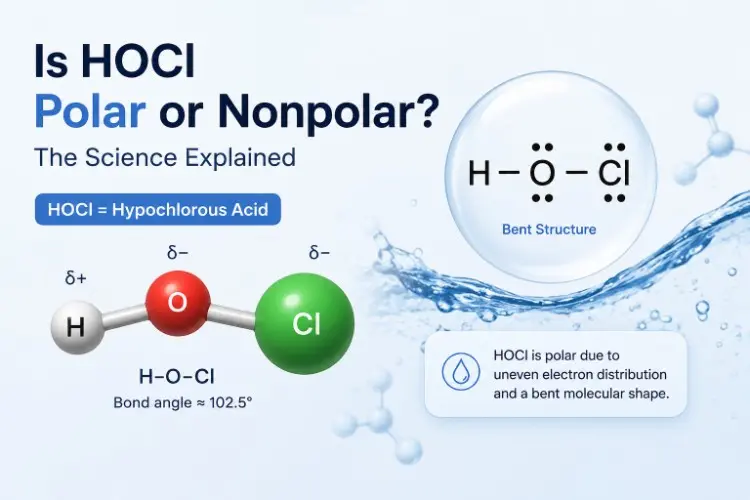
HOCl is polar, not nonpolar. Its structure is written as H–O–Cl. Oxygen attracts electrons more strongly than hydrogen. Chlorine also attracts electrons more strongly than hydrogen.
HOCl Has Uneven Electron Sharing
Because the atoms attract electrons differently, HOCl has an uneven charge distribution. We can show this simply as:
Hδ+ — Oδ− — Clδ−
The symbols show partial charges. They do not mean that HOCl becomes an ionic compound.
HOCl also has a bent molecular shape. Its H–O–Cl bond angle measures about 102.5°. This shape prevents the bond dipoles from fully canceling. Therefore, HOCl has a net molecular dipole.
HOCl Is Not an Ionic Compound
A polar molecule and an ionic compound are not the same thing. HOCl remains a neutral molecule in its molecular form.
In water, however, HOCl can separate into ions:
HOCl ⇌ H⁺ + OCl⁻
The balance depends strongly on pH. This balance plays an important role in disinfection.
Why HOCl Works Well in Water
HOCl has good interaction with water because both molecules have polar features. This allows HOCl to remain in an aqueous solution.
pH Controls HOCl and OCl⁻
The pH of the solution affects the amount of molecular HOCl and hypochlorite ion.
A simplified view looks like this:
· Lower pH: More HOCl
· Higher pH: More OCl⁻
· Near-neutral conditions: Both forms can exist
· Very high pH: OCl⁻ becomes more dominant
This balance matters because HOCl generally shows stronger antimicrobial activity than OCl⁻.
For this reason, pH control remains important when we operate an HOCl Generator. We also monitor chlorine concentration, water quality, and production conditions.
How HOCl Can Kill Bacteria
The polarity of HOCl does not explain all its antimicrobial action. Its chemical reactivity plays a bigger role.
HOCl acts as a reactive chlorine compound. It can react with proteins, enzymes, lipids, and other cell components.
HOCl Damages Microbial Cells
When HOCl meets a microorganism, it can react with important molecules inside and around the cell. These reactions can disturb normal cell functions.
This process helps HOCl kill bacteria under suitable conditions. Its action can also affect other microorganisms.
The final result depends on several factors:
· HOCl concentration
· Contact time
· pH
· Temperature
· Organic matter
· Water quality
· Type of microorganism
So, we should not judge a disinfectant only by its ppm value. Concentration × contact time gives a better starting point for understanding disinfection.
HOCl and Fungal Cells
HOCl can also act against some fungi and yeasts. Its oxidation reactions can damage important parts of fungal cells.
However, different fungi have different resistance levels. Spores may also need stronger or longer treatment.
Therefore, we should always match the treatment conditions with the target application. One number cannot solve every disinfection problem.
The Effects of Hypochlorous Acid
The effects of hypochlorous acid depend on its concentration and use. Research shows that HOCl has useful antimicrobial properties against many types of microorganisms.
HOCl and the Immune System
Our immune system naturally produces HOCl. Certain immune cells make HOCl during their response to invading microorganisms.
This fact makes HOCl especially interesting. Our bodies already use this molecule as part of natural defense chemistry.
However, natural HOCl and commercial HOCl products are not automatically the same. Product concentration, purity, pH, and intended use all matter.
We should also avoid making medical claims without proper evidence. HOCl products must follow the rules for their specific application.
What Does an HOCl Generator Do?
An HOCl Generator produces hypochlorous acid water through an electrochemical process. The system usually starts with water and a chloride source.
Important Generator Parameters
A good system should control several key factors:
Parameter | Why It Matters |
HOCl concentration | Controls treatment strength |
pH | Controls HOCl/OCl⁻ balance |
Water quality | Affects production and stability |
Flow rate | Controls production capacity |
Temperature | Affects solution stability |
Contact time | Affects disinfection results |
Storage | Affects product quality |
Common application concentrations can vary. For example, systems may produce solutions around 50 ppm, 100 ppm, or 200 ppm.
These values do not fit every application. We should always select the concentration based on the intended use and local requirements.
Can We Use an HOCl Spray?
A hypochlorous acid spray can support surface sanitation when the product suits the application.
Good Coverage Still Matters
HOCl needs contact with the target surface. A spray cannot disinfect an area it never reaches.
Cleaning also matters. Heavy dirt and organic material can consume available chlorine. For this reason, cleaning should come before disinfection when the application requires it.
We should consider four basic factors:
Concentration + contact time + coverage + surface condition
A higher concentration does not always mean better results. Good process control often matters more.
Why HOCl Polarity Matters
The question Is HOCl Polar or Nonpolar may sound like a basic chemistry question. Yet it helps us understand how HOCl behaves.
HOCl has:
· Formula: HClO
· Molecular weight: ≈52.46 g/mol
· Structure: H–O–Cl
· Shape: Bent
· Bond angle: ≈102.5°
· Nature: Polar
· Conjugate base: OCl⁻
· Main medium: Water
Its polarity supports its behavior in water. Its chemical reactivity gives it useful antimicrobial properties.
For us, this chemistry also guides equipment design. A reliable generator needs more than a high chlorine number. It needs controlled pH, stable output, proper water quality, and suitable production capacity.
Final Answer
So, is HOCl polar or nonpolar? HOCl is polar.
Its H–O–Cl structure creates uneven electron distribution. Its bent shape also creates a net molecular dipole. In water, pH controls the balance between HOCl and OCl⁻.
HOCl can kill bacteria and affect fungal cells because of its strong chemical reactivity. It also has useful antimicrobial properties and connects closely with the natural chemistry of the immune system.
At Shandong Shine Health, we believe simple chemistry leads to better technology. When we understand HOCl at the molecular level, we can make its production more controlled and practical.